The former Renault factory in Vilvoorde is one of Belgium’s most iconic industrial landmarks. The site forms part of a 150-metre-wide strip between the Vilvoorde viaduct and the town centre on one side, and the Schaarbeeklei and the railway line on the other. This historic industrial area has been designated as a catalyst site for a radical transformation into a dynamic urban environment combining logistics, industry, leisure and public amenities.
Under the guidance of Team Vlaams Bouwmeester and commissioned by the City of Vilvoorde, the design team comprising GAFPA, RE-ST, Kollektif and Suunta developed an integrated vision in which urban planning, mobility, landscape, public space and architecture come together in a visual quality plan.
The landscape serves as the foundation of the design, acting as a driving force for climate adaptation. The existing factory structures are interpreted as ‘intelligent ruins’ that create new urban possibilities whilst preserving the site’s iconic identity.
To reconnect the site, which has become organically silted up, with the surrounding urban fabric, the masterplan introduces the building block as a structuring principle. Between these building blocks, spacious green park areas are created, opening up new sightlines from the cross streets towards Schaarbeeklei. The former Renault factory is reintegrated into its surroundings by taking the existing cornice as a reference point. Its distinctive structure — a concrete slab topped by a light steel structure — forms the basis for a horizontal division that is carried through the entire development. The striking bridge over Broekstraat is also retained and takes on a new significance as a monumental city gateway.
The urban planning vision is, above all, an exercise in creating space: space for water and climate resilience, for new green parks and the reopening of the Woluwe, but also space for sustainable mobility. The Schaarbeeklei is being redesigned to benefit pedestrians and cyclists, whilst logistics movements are being consolidated along a new axis on the railway side. It is not the programme, but the existing condition of the site that forms the starting point: maximum reuse forms the basis for new urban potential.


A new woodworkshop is located behind an office building, on the edge of a triangular industrial zone near the highway. The available building area is constrained by the presence of an existing high-voltage cabin, which makes constructing a standard rectangular structure unfeasible. To address this challenge, the proposed design centers around a primary square space, complemented by a series of adjoining side rooms. By omitting two of these side rooms to allow room for the cabin, the layout accommodates the site’s unique constraints while preserving the integrity of the main space. The side rooms adjacent to the existing office building house the new office spaces, while the remaining rooms are utilized as additional storage. The corners are designed as canopies to facilitate the delivery of goods.
The primary structure features a white-painted steel framework with round columns. Wooden beams, two meters in height, span the square in one direction. These beams define a taller, recessed volume, allowing natural light to enter the central space from two opposite sides. The corrugated metal façade takes its cue from the existing office building, with its novelty subtly marked by a shift in orientation from horizontal to vertical. At the corners, industrially reused concrete blocks are dry-stacked without mortar, ensuring the entire structure is fully dismountable.


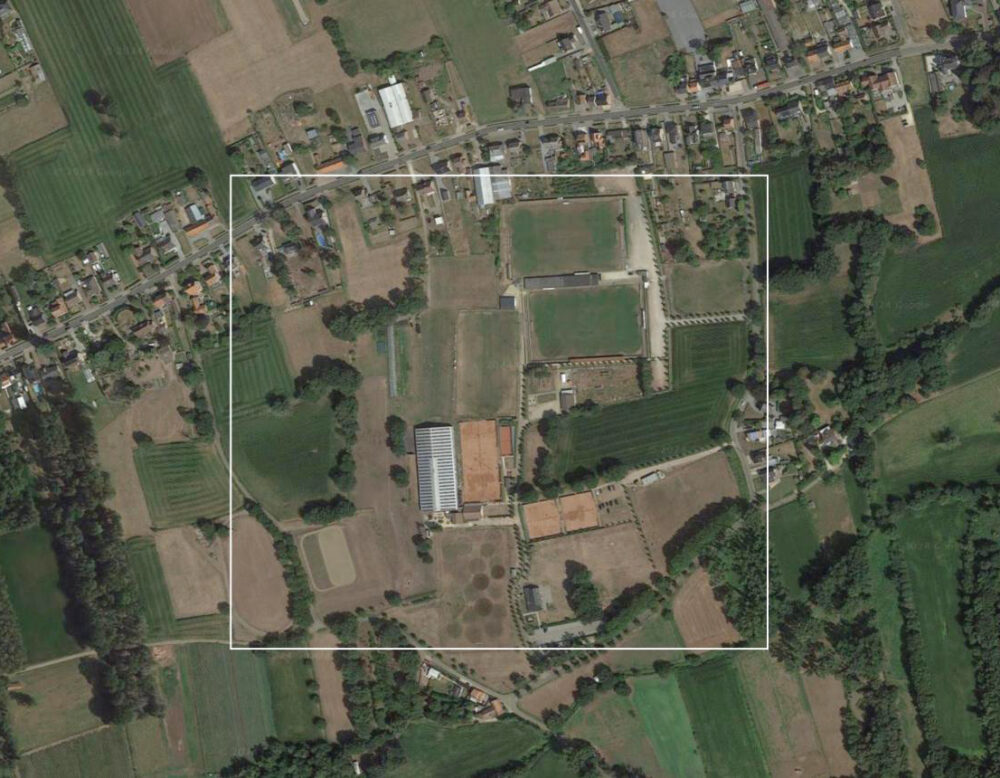
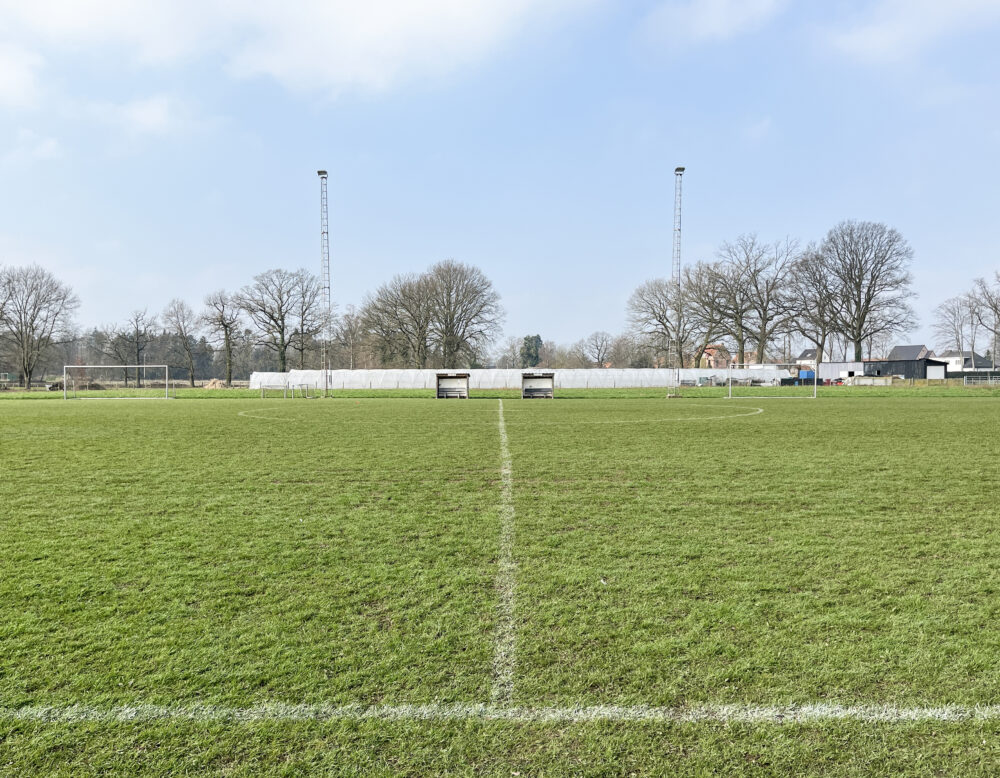
De Vloed is one of the three major sports and leisure sites in the municipality of Laakdal. Due to its organic growth, the site – despite its prime location – is struggling with fragmented land use and water-related issues. The masterplan sets out a new vision to spatially structure the site and make it climate-resilient.
Together with the various sports clubs and residents, a participatory process is being used to identify potential synergies. The historic landscape chambers are being restored and serve as a guiding principle. These chambers facilitate the various sports. Their edges, lined with trees and wild vegetation, create a network of walking and running paths, with space for a finely meshed wadi system that flows into one of the chambers, which is designed as a water storage facility for the entire site.
A single central, elongated canopy serves as the site’s flexible backbone. Beneath it is space for the infrastructure of the various clubs, with shared facilities, each offering a view of their own sports field. A nearby chamber is designated as a car park; other chambers are deliberately left empty and sown as a flower meadow. A new junction of walking and cycling routes connects the site to the natural corridor of the Laak Valley.



In a bend of the Ghent-Terneuzen Canal, opposite a steel giant, lies a mountain. This is the only point in the otherwise flat port landscape that offers a view of Ghent’s towers. The Solar Mountain, a remnant of a remediated brownfield, has now become one of the largest solar parks in the Benelux. Excess power, which cannot be fed back into the grid, is used there to produce hydrogen.
At the foot of the hill will be a nature education centre. This ambitious project, called Fabriek Energiek, aims to involve the general public in projects related to renewable energy in all its forms. It will also further expand and strengthen the existing educational programme for schools.
The design of the nature education centre, with its monumental sloping green roof, is a harmonious response to the hillside. The building consists of an elongated, rhythmic wooden structure, matched to the size of pressed straw cassettes. It stands on legs and has a loose prefabricated foundation, making it integrally demountable and reusable for the future. The wooden trusses that form the skeleton come from a recently demolished shed nearby.
The three-stage form of the plan stems from the search for the ideal dimensions for the different programmes. Utility functions, office space and classrooms each have a building depth tailored to their specific use. Each function opens onto a platform protected by a generous canopy on the south side. On the scaled north side, the three-stage form is visible in the façade. Three different window heights, in relation to the depth of the building, bring in northern light along the ceilings that follow the roof slope.
The building itself is educational and shows what it is made of. The straw construction method shows behind ventilated glass panels at the level of the central nave. The uniform façade rhythm of glass doors does not distinguish between functions and shows at the level of the storeroom which renewable technologies are used.
The neglected surrounding landscape is reforested and connects to the rugged nature of the Calemansputte. A new pedestrian bridge restores the connection to the adjacent social housing area.


In the southern part of Ghent, at the head of the Upper Scheldt valley, is Eiland Zwijnaarde, sandwiched between the Ring canal, the Scheldt canal of Zwijnaarde and an old Scheldt tidal arm. The E40, situated on a dyke body, divides the island into two parts. The southern part will be developed as a science park for university spin-off companies, focusing on sustainable research and development, while the northern part is intended for water-related industrial activities.
For Eiland Zwijnaarde Noord, GAFPA developed an overall vision in cooperation with the Stadsbouwmeester and the Ghent Chamber of Quality, anchored in a spatial image quality plan. This plan strives for unity, flexibility and circularity, despite the diversity of the industrial players. The project focuses on integral sustainability, access to water activities via the quay, large-scale solar energy production, water reuse, circular use of materials and ecology.
The masterplan is being concretised for the area between the E40 and the R4, with an approach road on the east side and a landing quay on the west side. The Heylen Warehouses plot comprises a large ‘black box’ for storage and transport, with an iconic double deck along the R4 executed as a monumental vierendeel resting on a concrete column gallery. The Verhelst site provides a centre for the sale, storage and handling of building materials, a showroom and a future building innovation centre. Here, the characteristic cantilever rack dominates with an elongated canopy of solar panels as a cornice across the entire perimeter.
The 87.000m2 site is divided into parallel strips for loading, unloading and storage, based on a 6x6m grid, creating space for dialogue and synergy between the exploitations. The different strips, with their own building systems, contribute to a common identity, supported by a limited material palette and distinctive architectural elements.
On the north side, an elongated choreography of trucks on a double deck resonates with the passage on the road, water and bridge. The south side reflects the same mutability with an ever-changing storage of building materials.


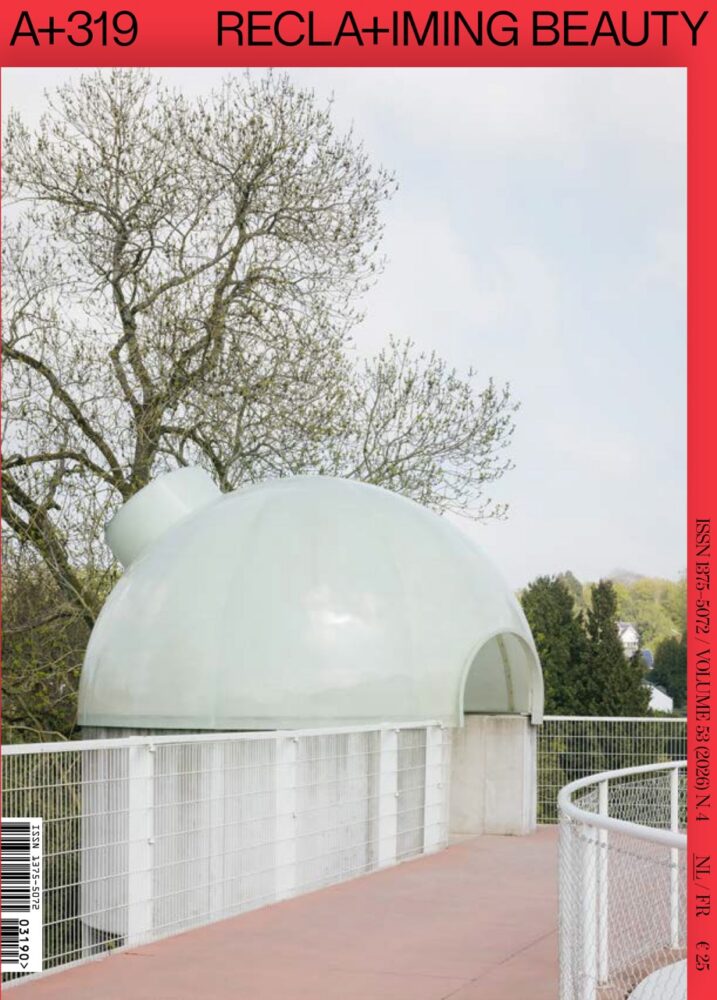
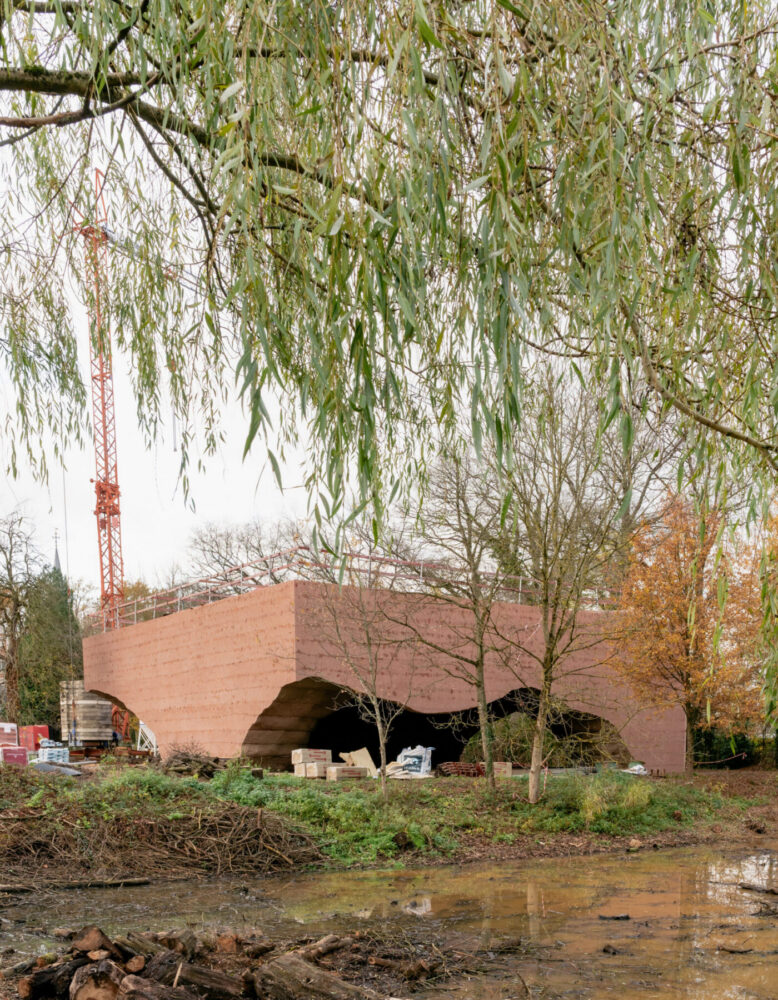
This book, published by Circo de Ideias, authored by Paulo Martins Barata, introduces the concept of metamodern architecture, a new sensibility that outgrows the irreconcilable tenets of the modern/postmodern debate.
In nine points loosely based on the principles of metamodern cultural theory – humour, media, collage, ornament, bricolage, technology, form, ecology and ethics –, the author attempts to signal this sensibility in a wide range of emerging practices. G1715 Visitor Center is included in the publication as a reference project.


GAFPA has been selected to design the Woonpunt Waas site in Beveren. Commissioned by the housing association, the existing buildings, originally conceived as single-purpose structures, will be transformed into a mixed-use development that strengthens the relationship with the surrounding public space.

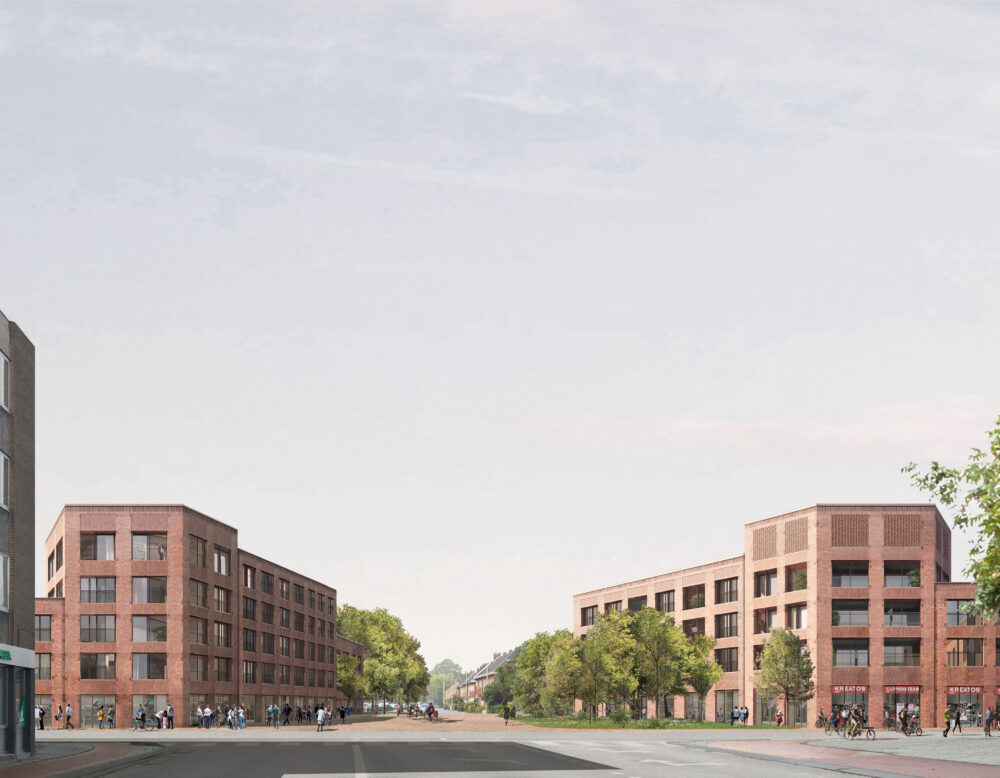
GAFPA and Kollektif Landscape have been selected to design the new natural swimming pool for het Provincial Domain in Kessel-Lo. On behalf of the Province of Flemish Brabant, the existing outdoor swimming pool will be replaced by a swimming pool with completely natural purification. An accompanying building and surrounding landscaping will also be constructed.


Building on the abstracted, urban archetypes of City Remnants (2023), BRUT Collective and vzw artecetera are joining forces for Arena. The word arena derives from the Latin “harena” or “sand”, and thus refers – once freed from competition – to a place in motion. As an architecturally defined stage, the arena offers a place for dialogue, doubt and friction. A place where ideas and existing structures are questioned, and where unexpected encounters and connections arise.
Arena encourages reflection on social themes such as urbanisation, architecture, heritage, decay, nostalgia, connection and collectivity. Spread over the three floors of the northern Broel Tower, Arena reveals its three layers: foundation, object and debate.


The Woonpunt Waas site is located along Oude Zandstraat in the historic centre of Beveren, where two residential blocks mark a strategic urban junction. The project transforms these existing structures, originally conceived as monofunctional volumes, into a mixed-use programme that strengthens the relationship with the surrounding public space.
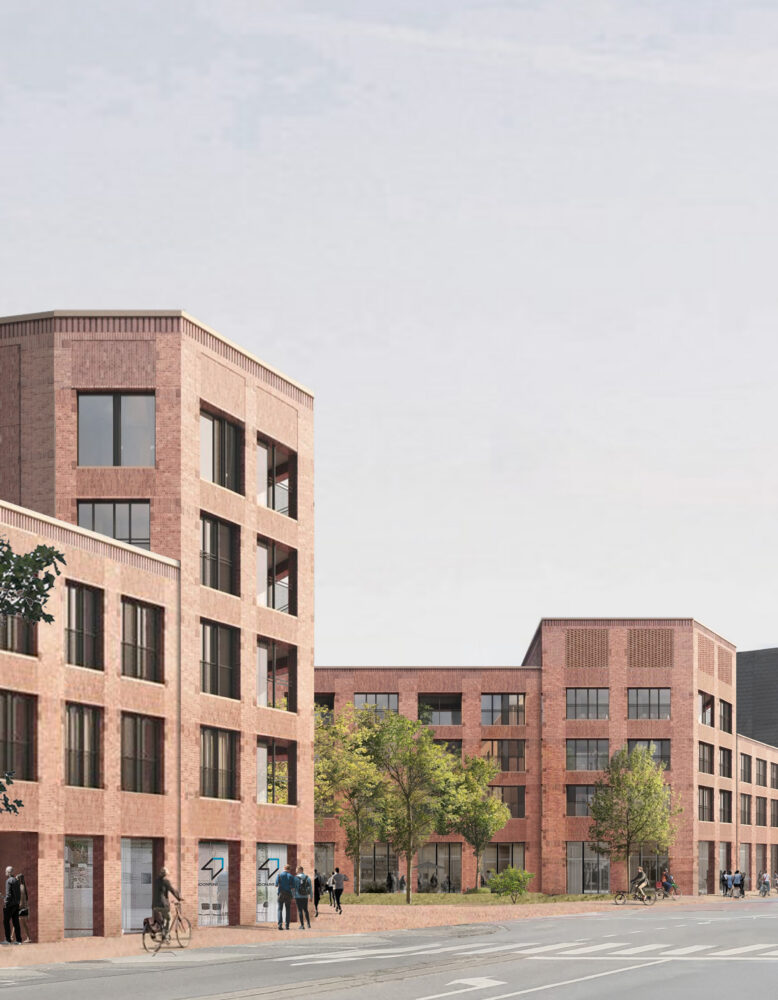
The research seminar is the second in a series of three seminars focused on the pedagogy of transformation in architecture, urbanism, and landscape. This edition will take place at the École Nationale Supérieure d’Architecture et du Paysage de Lille on Tuesday, March 25, and Wednesday, March 26, 2025.
The Seminar in Lille is dedicated to the theme of Resources. The sessions bring together a variety of contributions: practical approaches, historical-theoretical reflections, pedagogical proposals.
Floris De Bruyn will present a contribution to the session Resources and Techniques titled The Structure of Transformation. This research explores the relationship between analyzing existing structures and developing a design method for sustainable interventions. It builds on the work of GAFPA, whose approach relies on a typological interpretation of the As Found—a strategy that deconstructs existing contexts to reveal transformation opportunities. The theoretical framework is informed by the writings of Allan Colquhoun and Carlos Martí Aris, advocating a typological approach to design. To illustrate this methodology, the research draws on an expanding Atlas of drawings documenting existing structures, alongside pedagogical experiments in the Primary Structure Studio (KU Leuven, Faculty of Architecture, Ghent), demonstrating the potential of The Structure of Transformation as an ongoing research inquiry.
The Seminar is organized by Véronique Patteeuw and Mathieu Berteloot, ENSAPLille


At the invitation of the Faculty of Architecture at TU Darmstadt, GAFPA will give a lecture on Wednesday 21 May at 6 p.m. The lecture, entitled “Observations on Type”, explores the interaction between practice, theory and pedagogy. It examines how a typological analysis of existing structures can contribute to a sustainable design approach. Based on observations of typological principles, the projects presented are organised according to the categories Typos, Topos and Tectonics.

At the invitation of Bergen Arkitekthøgskole + Bergen arkitektforening, GAFPA will give a lecture on Wednesday 4 December at 7 p.m. at Kunsthall Bergen.
Architectural Practice is a lecture series in which exemplary practices from around the world are invited to share their current work.
www.kunsthall.no

The former Renault factory in Vilvoorde is one of Belgium’s most iconic industrial landmarks. The site forms part of a 150-metre-wide strip between the Vilvoorde viaduct and the town centre on one side, and the Schaarbeeklei and the railway line on the other. This historic industrial area has been designated as a catalyst site for a radical transformation into a dynamic urban environment combining logistics, industry, leisure and public amenities.
Under the guidance of Team Vlaams Bouwmeester and commissioned by the City of Vilvoorde, the design team comprising GAFPA, RE-ST, Kollektif and Suunta developed an integrated vision in which urban planning, mobility, landscape, public space and architecture come together in a visual quality plan.

The design team GAFPA, RE-ST, Kollektif and Suunta has been appointed to develop a new master plan for the Schaarbeeklei Oost zone, a 150-metre-wide strip between Schaarbeeklei and the railway line, north of the viaduct in Vilvoorde. This historic industrial area, with the former Renault factory as its most prominent relic, has been designated a lever site and will be transformed into a dynamic environment with various urban functions.
Under the guidance of Team Vlaams Bouwmeester and on behalf of the City of Vilvoorde, the design team is working on an overarching vision that brings together urban development, mobility, landscape, public space and architecture. The landscape forms the basis for research into softening, the reinterpretation of factory remnants as “intelligent ruins”, the integration of mixed programme functions and the preservation of the site’s iconic value.
The redevelopment of this iconic location is in line with the broader urban transition of the wider site into a pleasant residential, living and working environment on a human scale.


A former carpentry is hidden from view by a stately townhouse on the street side. On ground floor, the house is laid out with an original carriage entrance flanked by a front and back room. At the rear of the lot is the carpentry, constructed as a central space with two side aisles. The project transforms the whole into a residence with painting studio, preserving both the mansion and the carpentry in their original character with minimal interventions.

At the invitation of the Faculty of Architecture and Design Bratislava, GAFPA will give a lecture on Thursday 21 November at 8 p.m.
The lecture explores the potential of typological transformation in architecture. A series of mirror projects will be used to illustrate how the same basic type can be transformed using strategies derived from observation of the context.
www.singularch.sk


De Vloed is one of the three major sports and leisure sites in the municipality of Laakdal. Due to its organic growth, the site – despite its prime location – is struggling with fragmented land use and water-related issues. The masterplan sets out a new vision to spatially structure the site and make it climate-resilient.

GAFPA, together with Planrr and n.o.n.k.e.l, is the winner of call OAG 2401 from Vlaams Bouwmeester.
Our team has been selected to carry out the design study for the De Vloed recreation area. The project is located in the valley landscape of the Grote Laak and brings together various spatial themes.
To continue
In 1967, artist Richard Serra acquired a large quantity of industrial rubber left over after a bankruptcy. To discover the potential of the material, Serra drew up a list of verbs; actions that could be applied in relation to the material and in relation to the place. To fold, to cut, to twist, to dangle, to…
By performing these simple actions on the material from which they are derived, a series of works is created that will lead to a consistent oeuvre, a syntax of its own.
The task Serra set himself to find a strategy for dealing with the material at hand is comparable to the challenge architects face today. How to deal with the “as found”. The material architects are confronted with is no longer just raw matter. It is semi-finished products, structural systems, hybrids that need to be dismantled and reassembled.
The lecture explores the presence of typological operations in anonymous structures. Based on the archive built up in the Primary Structure studio, anonymous constructions, from historic palazzi to contemporary petrol stations, are compared with the work of GAFPA on the basis of similar operations present in them.

In a bend of the Ghent-Terneuzen Canal, opposite a steel giant, lies a mountain. This is the only point in the otherwise flat port landscape that offers a view of Ghent’s towers. The Solar Mountain, a remnant of a remediated brownfield, has now become one of the largest solar parks in the Benelux. Excess power, which cannot be fed back into the grid, is used there to produce hydrogen.
At the foot of the hill will be a nature education centre. This ambitious project, called Fabriek Energiek, aims to involve the general public in projects related to renewable energy in all its forms. It will also further expand and strengthen the existing educational programme for schools.

During the development of the Nature Education Centre in Zelzate, an unexpected opportunity for reuse presented itself: laminated timber beams from a warehouse in Kortrijk – at that moment being demolished – became available for repurposing. The design was adapted and structurally recalculated to match the dimensions and load-bearing capacity of the reclaimed beams.
By tailoring the design to match what was available at the moment of dismantling, the project sidestepped the need for storage and the logistical delays often associated with reuse. The primary structure incorporates reclaimed laminated beams, while the façade is clad with wooden cassettes once used for brick drying. Held in place by their original metal bands, these cassettes remain unaltered and fully reusable. To further reduce environmental impact, the entire building stands on screw piles – a lightweight, non-invasive foundation system that can be fully removed in the future.

Floris De Bruyn was a guest lecturer at the seven-day interdisciplinary winter school, where scenarios were designed for the Kortrijk-Noord industrial park and its surroundings. The students researched circular design principles and contributed ideas for circular transition scenarios aimed at regenerating the industrial built environment of Kortrijk-Noord.
Careful use of existing materials and intangible resources is the circular thinking approach of the winter school.
The winter school is committed to reparative and regenerative approaches and focuses on the art of repairing, reusing and repurposing resources in the landscape, infrastructure, buildings and their components.

Along the Ghent-Bruges Canal, an elongated plot overlooks the fields of Beernem. The single-family house is designed as a wooden framework with four bays, two of which contain a central roof floor.
A stepped stone facade captures and protects the wooden structure at the front and rear. The tripartite façade profile gives the structure its own identity and reflects a theme from its surroundings.
Between the end walls, a menier red profiled board serves as a finish to the side walls and roof. The placement of the windows in the front and rear façades reveals the underlying logic of the four-part plan.

From 5 to 7 September 2023, the Flemish Architecture Institute and Hasselt University will organise the international colloquium “As Found: Experiments in Preservation”. The colloquium is aimed at designers, researchers and students with a focus on concepts and practices that intervene in the existing built environment, or “as found architecture”.
Floris De Bruyn will participate in the debate “Architectural Experiments III”, moderated by Nadin Augustiniok..
The City of Ghent wants to centralise its logistics activities. This upheaval requires a thoughtful approach that takes into account today’s needs while providing sufficient resilience to accommodate growth and shrinkage demands, to allow for new infill and to support an evolving site identity.


Hogeschool PXL is constantly evolving, with a strong focus on innovation and multidisciplinarity. The new Business Hub on the Hasselt campus symbolizes this dynamic transformation. The Hub will serve as the new gateway to the campus, uniting education, research, and business. This initiative is part of a masterplan to transform the site into a contemporary Campus Park, socially, ecologically, and economically integrated with the city of Hasselt.

The demand for a new office building on the Fedustria site is linked to the development of a masterplan for the wider area of The Loop. Building on the principles of ORG’s overarching study, it supports the transformation of The Loop into a vibrant, multi-modal urban district. The key lies in the introduction of a human scale, a shift away from the dominant ‘brochette model’ to a chessboard pattern.

Karl Popper, in his Three World Theory, describes three distinct worlds: the physical material world, the subjective world and the abstract mental world. Reality is created through the interaction of these three worlds. The architect belongs to the subjective world and, through abstract ideas, creates a design that bends the material world to his will.
The group exhibition ‘Objets trouvés’ opens on 11 May at the Cité de l’Architecture et du Patrimoine Paris.
curator: Thibaut Barrault en Cyril Pressacco


Karl Popper, in his Three World Theory, describes three distinct realms: the physical material world, the subjective world, and the abstract mental world. Reality emerges from the interaction between these three worlds. The architect belongs to the subjective world and, through abstract ideas, creates designs that shape and manipulate the material world.
In the garden of the ‘EDEN’ Hotel, Herzog & de Meuron designed a canopy in which the four letters of the name serve as slender supports for a square concrete grid. The letters, a found element, acquire a unique and unexpected form in their stretched typographic expression, giving each of the four columns its own identity.
For the exhibition Objets trouvés, we explored the possibility of representing architecture through found objects. The ‘EDEN’ pavilion functions as an idea, quickly materialized using four glue bottles and a rubber gym tile. The project is not only a tribute to the architectural reference, but also to the transformative potential of objects—activated by the power of an idea.

The GOING PUBLIC programme of the Faculty of Architecture highlights current debates in the studios, study programmes and research groups. The programme consists of a series of lectures that bring the discourse to the faculty and, vice versa, bring internal discussions to the world.
The lecture series is an initiative of the KUL Faculty of Architecture, Sint-Lucas Ghent campus.
The site is located at a traffic intersection with two layers: the junction of motorways on the one hand, and the junction of the old Scheldt and the Ring Canal on the other. The development of the site is part of the master plan for Eiland Zwijnaarde Noord drawn up by GAFPA.
Although the empty plot on the TACT site suggests otherwise, the planned ‘StadsAtelier de Ville’ cannot be a conventional new building. Unlike the residential development opposite Tour&Taxis, it will be a temporary spatial constellation, determined by a concession on the land, granted for a period of 30 years. After this, it should be able to be dismantled entirely, with the materials awaiting a new use.

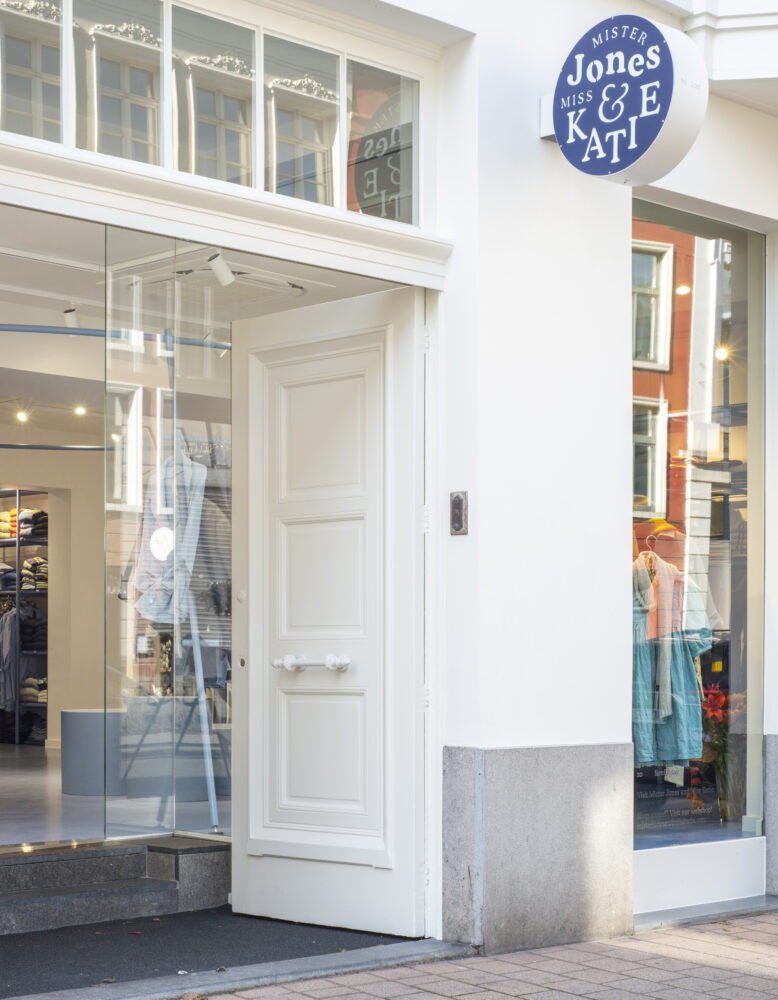
At the centre of the space is a circular steel structure. It dominates the interior of the shop and creates a focus in the unbalanced structure of the floor plan. With its slightly conical shape and blue hue, the tubular steel structure recalls a playground climbing frame. Dressed with the collection, it creates vistas that change with use. The language is continued in two linear shelves along either side of a deep niche.
Embedded between the canal and the highway is a linear industrial area. The last zone of this is being cut for development. The allotment plan has been drawn up, the lots determined. Smaller SMEs are housed here as residential detached villas. Each in its field.
The master plan questions this logic and seeks a shared answer on a larger scale. It goes in search of an identity tailored to the place. The site is divided into three, with the central part connecting to the adjacent sculpture park. This will be the green heart of the new campus. One parking tower solves the mobility issue and makes the connection with the other two parts by means of a bridge. The logistics are handled on two decks on both sides. One grid structures the site and makes a sub-scenario possible in the future.


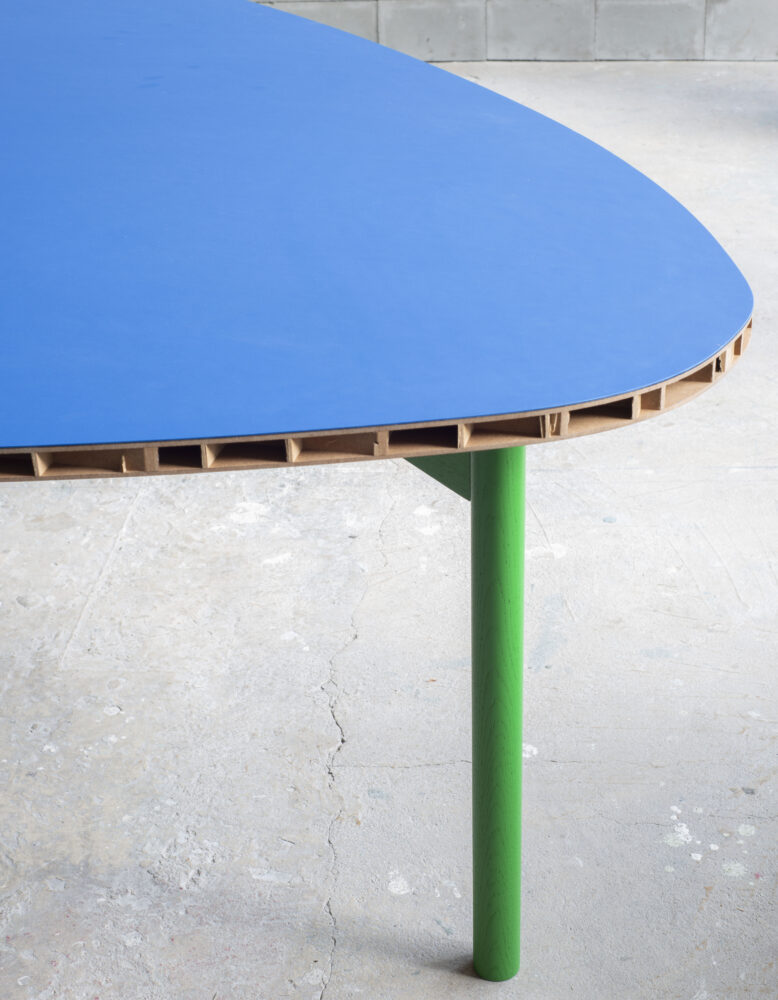
The triangle shape gives rise to the idea of a table with three legs. The tabletop takes the form of an ellipse. The shape of this ellipse can easily be determined using a plank, three nails and a piece of string. This method is also known as the gardener’s ellipse. The legs are connected using a wooden T-shape. A diagonal crossbar, connected to the tabletop at its points, provides the necessary stability. The tabletop consists of a wooden MDF sandwich panel, the grid of which is cut by the ellipse.
The tabletop is finished with a linoleum top layer. The base and tabletop can be dismantled for easy transport. The table is available in three variable combinations of two complementary colours. Due to its materiality, the table has the quality of a 1:1 scale model. A permanent prototype.

At the invitation of Professor Sergio Altomonte, GAFPA will give a lecture at UCLouvain on 22 March. The lecture, entitled “Architecture as Theme”, is part of the “Daylight Talks” series organised by the VELUX Group.
www.daylightandarchitecture.com

A new woodworkshop is located behind an office building, on the edge of a triangular industrial zone near the highway. The available building area is constrained by the presence of an existing high-voltage cabin, which makes constructing a standard rectangular structure unfeasible. To address this challenge, the proposed design centers around a primary square space, complemented by a series of adjoining side rooms. By omitting two of these side rooms to allow room for the cabin, the layout accommodates the site’s unique constraints while preserving the integrity of the main space. The side rooms adjacent to the existing office building house the new office spaces, while the remaining rooms are utilized as additional storage. The corners are designed as canopies to facilitate the delivery of goods.

In the construction of a new timber production hall, circularity is the central principle. All techniques used are fully demountable and designed for reuse. The lightweight cladding in profiled metal sheets and the steel structure follow well-established circular methods.
The main challenge lay in the loading and unloading bays, where concrete was required for reasons of durability. To meet this need without compromising the circular ambition, industrial stacking blocks were reused—massive concrete elements that, like oversized LEGO bricks, fit together without mortar. This approach avoids waste, allows for future disassembly, and gives the building a bold, robust character. In this way, reuse becomes not only a technical solution but also a defining aesthetic quality of the project.

In the southern part of Ghent, at the head of the Upper Scheldt valley, is Eiland Zwijnaarde, sandwiched between the Ring canal, the Scheldt canal of Zwijnaarde and an old Scheldt tidal arm. The E40, situated on a dyke body, divides the island into two parts. The southern part will be developed as a science park for university spin-off companies, focusing on sustainable research and development, while the northern part is intended for water-related industrial activities.
For Eiland Zwijnaarde Noord, GAFPA developed an overall vision in cooperation with the Stadsbouwmeester and the Ghent Chamber of Quality, anchored in a spatial image quality plan. This plan strives for unity, flexibility and circularity, despite the diversity of the industrial players. The project focuses on integral sustainability, access to water activities via the quay, large-scale solar energy production, water reuse, circular use of materials and ecology.

At the invitation of Colby Vexler, Kate Finning, Andrew Power & Pricilla Heung from the Melbourne School of Design, GAFPA will give a lecture on 28 September at 10.30 a.m. on the theme of “A House and its Ideal Neighbour”.

On a triangular plot in Tisselt, along the former railway, an infill development of about a hundred houses is planned. The surroundings are characterised by a lack of fabric, typical of the Flemish urbanised landscape.
The design provides for a series of slender volumes that graft themselves onto the landscape in the form of a double ridge structure, thus safeguarding the view. Linear semi-detached houses are mirrored around a common car-free residential yard. The width of the street profile varies as a result of buckled volumes that incorporate the slope of the site.Two identical taller volumes mark the public space and house the community functions of the community centre and nursery. The woodland at the tip is deliberately left undisturbed.

The competition proposal is the fourth phase of the Hoge Rielen master plan. Building on the intentions of Secchi Viganò’s 2004 master plan, we analysed the assignment from three perspectives: military, educational and natural.
The spatial requirements for overnight accommodation are met within the existing ammunition storage areas. These are being renovated in accordance with various tactics inspired by the typology of military infrastructure. Light, reversible structures in and around the existing sheds provide contemporary comfort within the original structure. In terms of landscaping, we are focusing on robust developments that anticipate climate change, including heathland reinforcement, the partial filling of the Rulloop to raise the groundwater table and, in time, achieve peat formation, and a meandering pattern of mixed forest that creates maximum valuable forest edge.
The solution to the spatial requirements was found in existing elements, with all interventions embracing the beauty of what is already present on the site today.

Situated at the sharp corner of a building block in the new Tondelier district, the doctor’s practice occupies a wedge-shaped site. The spatial organization is defined by a series of parallel wooden walls spanning across the site. A longitudinal corridor cuts through these walls, linking the individual consultation rooms with the central lobby.


At the invitation of Paul van Hontem, GAFPA will give a lecture on 1 June at 7.30 p.m. You can watch the lecture via www.architectuurcentrumnijmegen.nl
At the invitation of Daniel Movilla Vega, GAFPA will give a lecture on the theme of “Construction Detail”. The lecture will take place on 29 March at 1.30 p.m.
At the invitation of Stefan Simion, GAFPA will give a lecture on 18 March at 1 p.m. You can watch the lecture via www.mazzocchioo.com

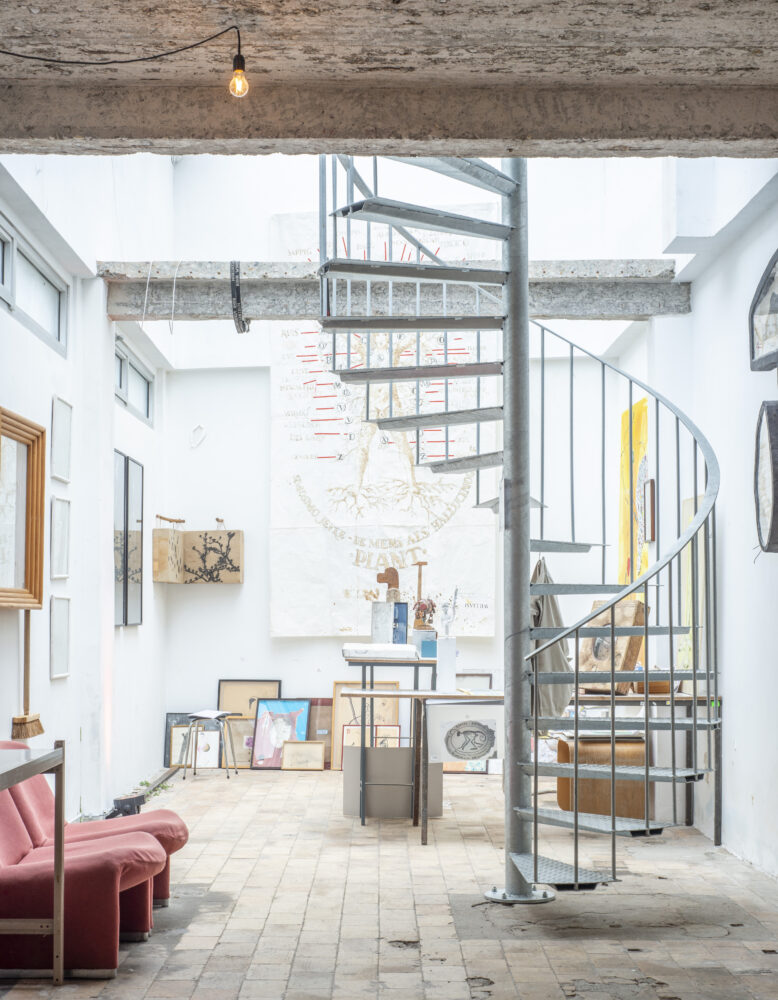
A regular concrete structure takes up the entire depth of the kinked plot behind a terraced house. The house is being thoroughly renovated, the living areas are located on the first floor. The roof slab is being cut out from the two rear bays of the former ground-floor warehouse. Topped with a light greenhouse structure, this intervention brings light into the ground-floor art gallery. A steel canopy, new rubble stone flooring, a concrete bench and tree accommodate the roof terrace above. A light spiral staircase connects both worlds.


Just outside the historic city walls of Amersfoort lies a former military hospital. The complex, separated from its residential surroundings by a moat, is awaiting a new function. A forgotten island amid advancing urbanisation. Various buildings are arranged in military order, mirrored around a central axis. Like a crab, a central main building stretches out its arms and connects the separate linear volumes. Two later-built H-shaped plan typologies break the symmetry. The requested programme includes residential care, housing, co-working, fitness, medical care, and a hotel with a cafeteria. A mix that should revive the island.

Behind a typical terraced facade with garage, a former warehouse is hidden in a dense urban building block.
The regular rhythm of a concrete frame structure fills the entire ground floor of the narrow deep plot where living, studio and outdoor spaces intertwine. Two fully cut away bays create a caesura between the main building and the rear building. By also cutting away the last travée, the studio receives light along large sash windows on both sides. Centrally on the five bays, an elongated opening is provided between two upright roof beams. Three metal grilles slide over each other and allow zenital light to be filtered. The system, inspired by the cover mechanism of a packet boat, runs on wheels and can be operated manually via a ladder in the rear patio.


The Milan edition of The State of the Art of Architecture focuses specifically on young, emerging architectural practices. The starting point will be a three-day conference which, similar to Tigerman’s 1977 conference, invites each participant to give a presentation of a recent project that embodies their vision and ambition in architectural terms. The exhibition will be formed in real time based on the contributions – models, materials, samples, drawings, images – presented by each participant and will remain on display until early April 2020.
GAFPA commissioned Les Monseigneurs to create a carpet for this exhibition. The work fits across the width of the gallery, allowing the viewer to become part of it.
The State of the Art of Architecture is curated by Joseph Grima, chief curator of Design Triennale Milano, and Sarah Herda, director of the Graham Foundation Chicago.
www.triennale.org
(fotografie: Gianluca Di Ioia)

A new office complex in Waregem serves as an extension for TVH’s offices. The assignment includes the design of a visitor centre on the ground floor.
A framework of aluminium box profiles forms the language with which the scenography is designed. This spatial frame is used alternately as a plinth, table and furniture. Enclosed by transparent plexiglass, it functions where necessary as a display case in which both the components and the technology necessary for the installation are exhibited.
These primary forms accompany the route and interact with the grid of concrete columns.

A former bank office becomes, once again, a home. Once rudimentary, the townhouse was transformed into a reception with office space with a concrete vault at its heart. Stripped down to its primary structure, the remnants of both lives are made visible.
Perpendicular to the direction of the original three-part townhouse plan, a strip model is projected. This radically new organisation incorporates both the vault and a new rear extension, stretched between the plot boundaries, into its logic. Where necessary, it cuts away, modifies or supports. The choices made remain visible and merge with the previous ones. The new extension in cross-laminated timber continues the language and texture of the existing concrete ceiling. A generous opening in the upper floor provides light and opens to the rooms above via a spiral staircase. The massive vault is given a patio as a mirror image.

In the conversion of a former bank building in Zwijnaarde, reuse is the guiding principle. By stripping the structure down to its primary framework, space is created for a new interpretation in which existing elements are given a second life. The old bank vault is preserved and given a central place within the new home.
A radically new strip layout, aligned with the dimensions of the vault, cuts through the original tripartite floor plan and connects old and new, including a timber extension in cross-laminated wood that continues the logic of the original board-formed concrete. Where necessary, interventions are made—but always with respect for what was there: what is demolished leaves visible traces; what is preserved is openly integrated. The result is a layered composition in which different eras converge, and reuse becomes not only material but also narrative.

On Thursday 7 November, GAFPA will give a lecture for the Norwegian Architects’ Association.
The lecture will take place at 7 p.m. at Josefines gate 34.

A compact row house facing the street is being given a new garden room. The new volume mirrors the floor plan of the existing house deep within the garden, creating a front and rear section connected by a covered gallery.
Three concrete piers, covered by a canopy, provide shelter and mark the transition to the garden behind. The same piers, with their spacing determined by the width of the plot, reappear rotated at right angles between the patio and the walkway. The rhythm of the windows sweeps open into the depth of the piers, transforming into a colonnade.
A system of pots and beams structures the ceiling. In the square garden room, it is supported by a black-painted steel column and steel beams which together form a T-shaped structure, thereby defining the character of the open-plan living space.
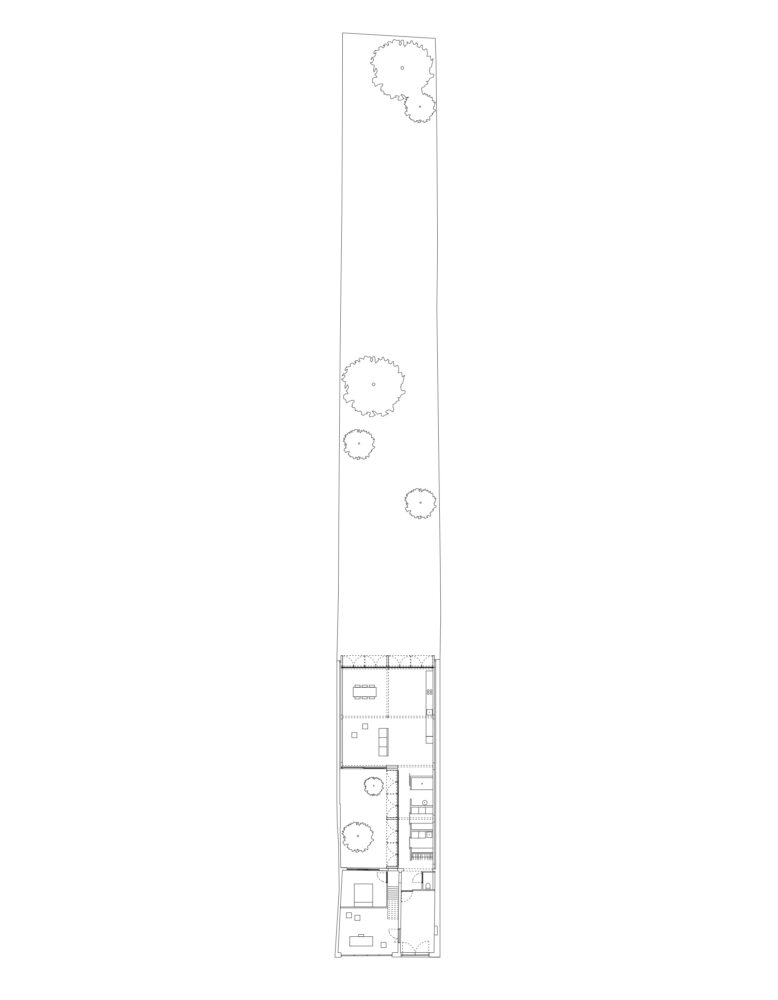


The last resident of the Le Paige estate donated her castle and the surrounding park to the City of Herentals on condition that the neighbouring dilapidated emergency church be replaced by a new church. The designated site is located along the northern entrance gate, right on the old ramparts.
On this historically significant site, three spaces are constructed from reclaimed brick within the perimeter of a square. The defensive mound, eroded by time, is locally reconstructed in the form of an earthen mound surrounding the three volumes. Cut off by the square, the mound forms the natural formwork for a vault. The context provides the materials for the intervention. The earth for the mound comes from the deepening of the moat. The existing church is recycled as granulate for the cyclopean concrete with which the formwork is filled to the top.

In the Herentals church project, re-use operates on two levels: material and typological. Bricks salvaged from the demolished old church were given a second life, grounding the new design in the physical memory of what was lost.
But beyond materials, the design also reclaims a forgotten spatial type—the grotto. Drawing on historical research into castle parks and their spiritual landscapes, the project revives the grotto as a space of reflection and shelter. Reimagined as a reconstructed hill formed from earth excavated on site, the vaulted interior encloses three brick volumes—a chapel, baptistery, and sacristy. This layered reuse, of both matter and meaning, anchors the new church in its context while offering a timeless, contemplative space.

The Lübeck site has an atypical shape, embedded in the existing cadastral structure. To the north, the site is confronted with an impassable railway infrastructure, camouflaged in a green verge. On the south side, Afrikalaan forms a chain of “roadside shops”. There is limited accessibility along the edges of the site and minimal visibility.
The City of Ghent has consciously chosen to house its services here in a new, yet very familiar environment. “Social innovation” starts from strengthening social relationships, focusing on the connections and intertwining between people. These serve as the basis and lever for upgrading the living environment.


Op dinsdag 20/11 geeft GAFPA een lezing om 18.30u aan EPFL Lausanne.
A narrow terraced house on a deep plot in the city is stripped and redesigned into a home with a studio. Every intervention remains visible. The concrete skeleton is retained and surgically modified with brickwork, wooden beams, steel columns, and plywood interior walls. The new staircase is accessed through a concrete sculpture by artist Bram Vanderbeke.
At the rear, the brick barn is transformed into a studio. The gable roof is sloped, and the facades are reinforced with a yellow steel structure that refers to temporary scaffolding. A wooden structure is stretched between the end walls, following the sloping roof line and fitted with a canopy. The studio overlooks the inner courtyard. Below it, a covered outdoor space is created that connects to a walled garden.


At the invitation of The Architecture Foundation, Drawing Matter and Veldwerk, GAFPA contributed to the exhibition project ‘Alternative History’. The project starts from an imagined alternative future for a design drawing from the past, and results in the form of a new model.
‘GAFPA: ON SUPERSTUDIO’S CONTINUOUS MONUMENT, 1969’ will be on display from 23 March to 14 April in London.

At the invitation of curators Jantje Engels and Marius Grootveld, GAFPA will participate in a debate on 12 September alongside Stephan Bates, Anne Julchen Bernhardt, An Fonteyne and Paul Vermeulen as part of the group exhibition ‘Alternative Histories’.


Wood construction company Lab15 is getting a new workplace. An industrial building made of wooden V-beams on a concrete column structure is being pushed up against the side boundary of the plot, enclosed in a U-shaped fire wall made of prefabricated concrete panels.
The layout, the slightly sloping profile of the roof trusses and a slender steel canopy give the building its own orientation, turning the free side façade into the new front façade. Prefabricated wooden façade cassettes and a generous skylight take over the scale of the concrete elements of the fire wall.
The office, inserted as a narrow solid wood construction in the end bay, is separated from the production hall. A covered courtyard is created in the centre of the building. Locally, the concrete columns disappear and a wooden four-part beam marks the entrance to the building.
Architectuurprijs Gent 2021, 1e Prize public jury


GAFPA wins the Ghent Architecture Prize 2021 awarded by the public jury.
The public jury, a group of 25 Ghent residents with a passion for architecture in Ghent, selected three projects that combine architectural aesthetics and social added value. The G1812 commercial building for LAB15 was declared the winner. According to the jury, the project is exceptional due to its progressive and well-functioning vision of the working environment, its clear and poetic architecture, and its special attention to sustainable construction.
www.architectuur.gent


Architecturebook #4 The Eugeen-Tanja Selection is a selection by Eugeen Liebaut from the work of students in perspective with the work of their teachers, with contributions from various authors. In Practice supports the book by organising the double-blind peer review of the text contributions and by participating in the editorial committee.
www.architectureinpractice.eu

The third issue of Practices in Research is a project of the inter-university research group In Practice, supported by ULiège, KU Leuven and ULB. “In Practice” invites practising architects to explore the many ways in which architects can engage professional practice with academic research and vice versa. ‘Practices in Research #03 – Explorations&Cartographies’ broadens the work initiated in the first and second issues, increasing the diversity of approaches, topics and profiles.
GAFPA contributes with “PRIMARY STRUCTURES Factories”. You can download the publication via www.architectureinpractice.eu

Today, architecture is confronted with social upheavals that are becoming increasingly difficult to ignore. The housing issue, shifting views on education, the collective past, public space and new care needs are themes that are becoming more urgent by the day. The hesitant response to these issues puts the (international) success of architecture from Flanders and Brussels into perspective.
The Architecture Book Flanders N°15, Alliances with Reality, brings together a rich selection of recent high-profile projects that offer surprising answers to these challenges. Ten essays and two photo series offer a critical reflection and hold up a mirror to the field of architecture. Alliances with Reality appeals to the social commitment and social entrepreneurship of all those who contribute to the (un)built environment.
With essays by Livia de Bethune, Sofie De Caigny, Maarten Desmet, Hülya Ertas, Marleen Goethals, Petrus Kemme, Marc Martens, Mark Pimlott, Martino Tattara and Kiki Verbeeck.
With visual essays by Sepideh Farvardin and Miles Fischler.


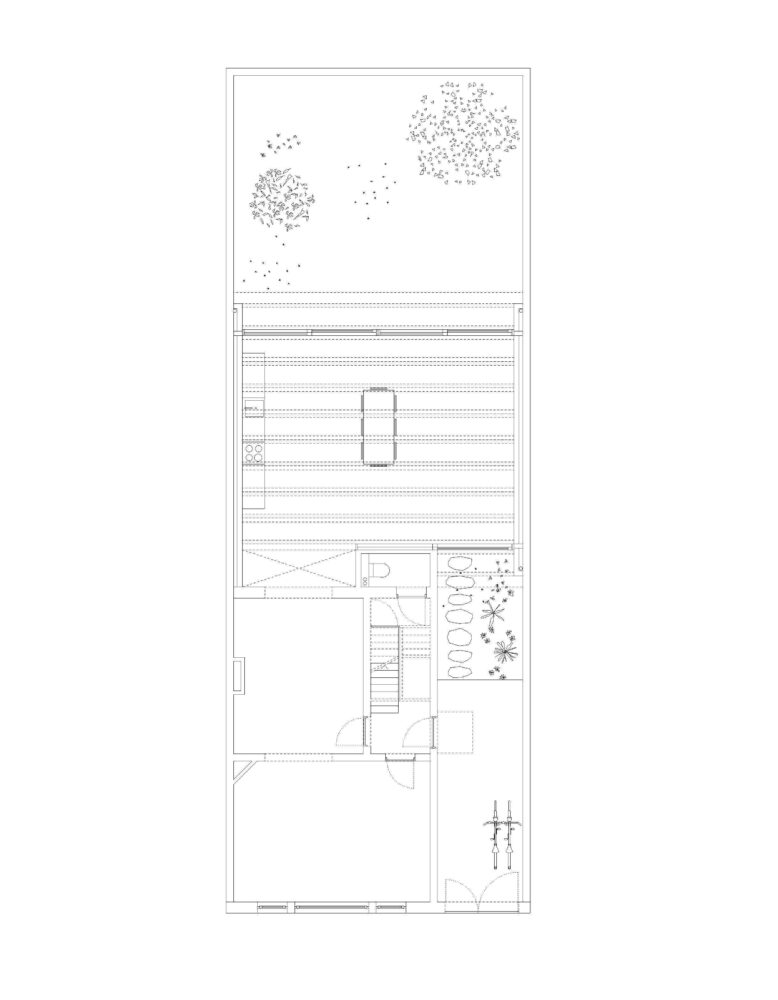

At the invitation of curators Rodrigo da Costa Lima & Amélia Brandão Costa, GAFPA is showing a short film by G1508 at the group exhibition “Building Stories” at CCB Lisboa.
The exhibition runs from 10 July to 14 October.

On Thursday 19 April, GAFPA and RAAMWERK will give a lecture at 8 p.m. in deSingel. The lecture is part of the exhibition COUSSEE & GORIS architects – Natura Naturans and is an initiative of the Flemish Architecture Institute.

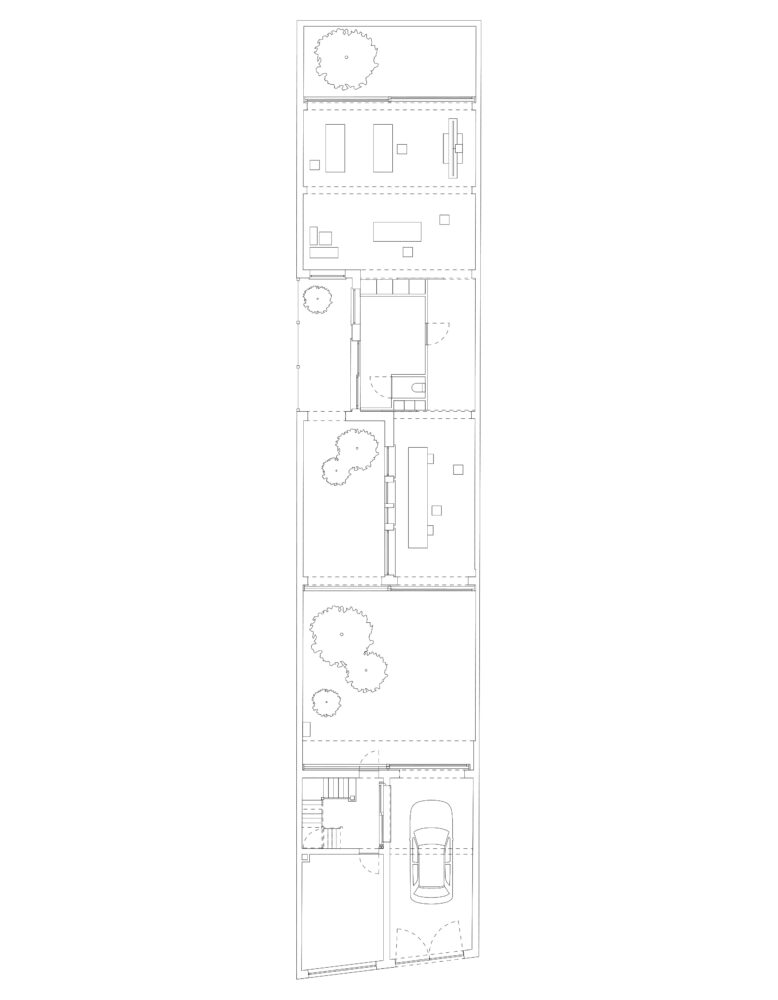
The two parts of a castle estate will be reunited after years of splitting. The neoclassical mansion at the entrance gate will be restored and given a new residential function under its undulating roof.
In the garden under a group of centuries-old red beeches, three park villas will be arranged around the historical view axis of the castle. Their plan form arises from three rooms arranged around a stairwell around which terraces are wrapped. Due to their sculpted form, they inscribe themselves along the meandering paths through the historic park garden.

Based on 130 submissions, the Ghent Architecture Platform drew up a shortlist of 20 projects that improve Ghent. GAFPA was nominated with the Potuit housing project.


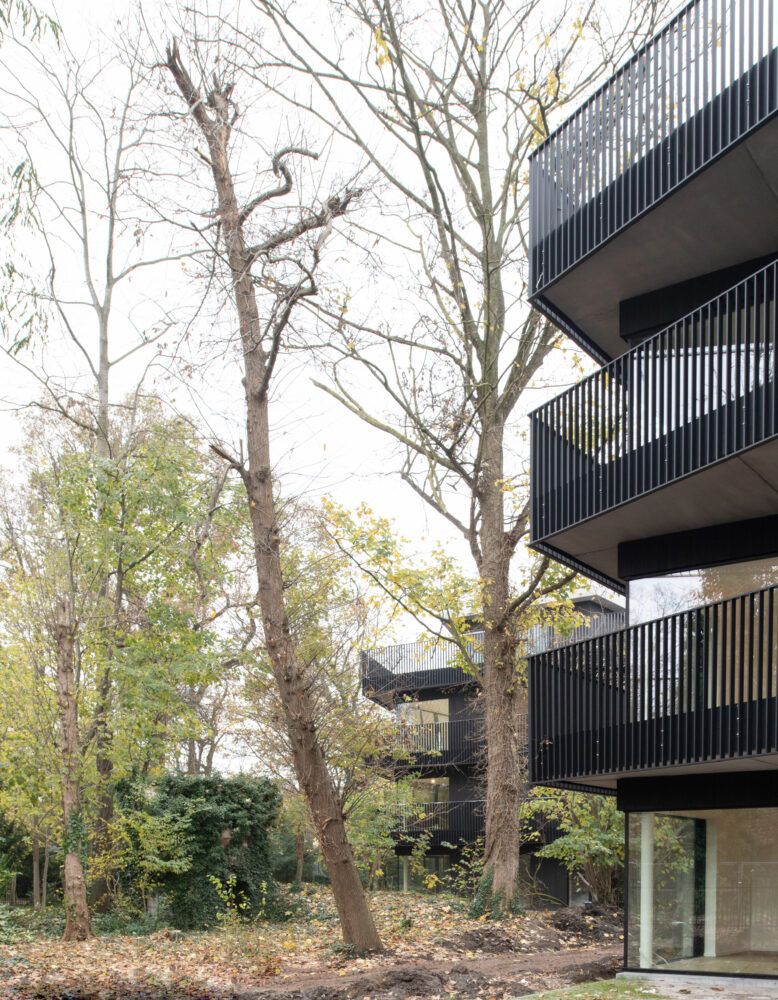
GRAM is a multifaceted research tool that combines graphic research with architectural explorations. It portrays the methods and processes of architectural firms over the course of ten emails. The results are both theoretical and practical, opening the doors to the endless thought processes behind the production of space.
www.qndmc.com

In the middle of the fields of Lierde, at the intersection with a railway line, stands a farmhouse. The open landscape is marked at regular intervals by square farmhouses.
The existing house is extended with two new rooms. The volume takes over the dimensions of the existing house, is cut to length and mirrored diagonally. A new entrance is created in the open corner of the L-shaped floor plan.
The plan refers to the logic of the square farmhouse, where each extension grows around a sheltered courtyard. The wooden roof trusses span from gable to gable, leaving the spaces free and opening up across the entire width of the façade to the surrounding fields.
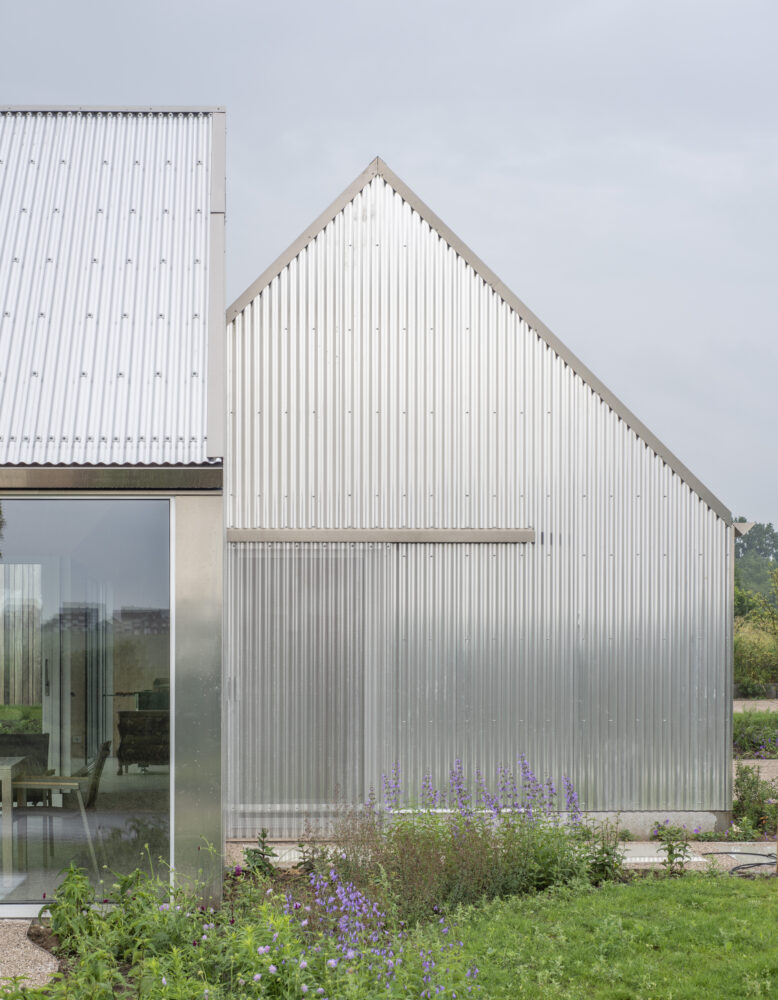
The extension of a country house in Lierde was conceived as a reinterpretation or ‘re-use’ of the existing typology. The L-shaped plan features a recessed ‘open corner’, with two identical gable roof sections interlocking, mirrored along a 45° axis. The design blends seamlessly into its surroundings, enhanced by silver cladding that evokes the image of a doubled shed—a motif reminiscent of Georgia O’Keeffe’s Ends of Barns series.
Inside, the monolithic exterior opens into a continuous, open space. Like a house of cards, both the walls and roof are constructed from the same material. The solidity of the outer corner is counterbalanced by the dematerialization of the inner corner, made possible by interlocking roof canopies acting as giant beams. The exposed CLT shell reveals the construction process, highlighting its structural logic.
The typological strategies applied in the project can be read on different scales. At an urban level, the L shaped extension echoes the initial stages of forming a square barn, typical of the surrounding area. The structural logic of the existing barn—bearing perimeter walls and an A-frame—is reinterpreted as a shell structure, transforming the traditional type. By altering the span direction and engaging the roof canopies, both sides can become transparent. Drawing inspiration from various barns and their corner conditions, the solution is typified, abstracted and geometrically idealized, evolving into a formal and artistic exploration. The barn is deconstructed into its essential components and reassembled to suit the specific context and material translation, resulting in a contemporary reinterpretation of the type.

The site, located in the centre of Petegem, is indirectly connected to the main access road through the village. A central sightline runs straight through the site to St Martin’s Church. The peripheral area at Kastanjeplein serves as a linear parking zone.
Large, valuable existing trees give the site an exceptionally green character.
The starting point for the design is the central axis of sight towards St Martin’s Church. The pedestrian crossing is extended in the new master plan to the opposite side. To ensure good accessibility of the site, a new crossing is provided across this axis between Krauwelstraat and Kastanjeplein. An elegant elongated volume is planted along this cross shape. The volume is intersected by the circulation axis, creating a framed view of St Martin’s Church. A subordinate volume with single-family dwellings connects to the immediate context.


GAFPA wins the architecture competition for the construction of a residential project in the centre of Wortegem-Petegem.
The main volume consists of 19 residential units with covered terraces facing the park garden of Kastanjeplein.

A new reception building for the Negenoord nature reserve is being constructed along the banks of the old Meuse arm. An information point and an exhibition space are stacked on top of each other in an elongated tower volume, enclosed between two solid concrete cores. Slender TT floors span a free field of ten metres from core to core, leaving the front and rear façades transparent.
A light steel skeleton is being built around the concrete building, leaning forward towards the water and wrapped in cable mesh. Between the building and the second skin, two external staircases are fitted at the ends, winding their way up from the dyke to a public viewing point on the roof.
Over time, the steel structure will be overgrown with climbing plants, allowing the building to blend into the landscape.

GAFPA, together with Madoc, wins the architecture competition for the expansion of the Maascentrum De Wissen in Stokkem into a reception and experience centre.


On Wednesday 13 December, GAFPA will give a lecture at 6.30 p.m. at Kingston School of Art in London. As part of the lecture, an interview by Andrew Clancy can be listened to via podcast.

The Lange Munte sports campus, located in Hoog Kortrijk on the border between residential and agricultural areas, is getting a new master plan. GAFPA is developing a vision for the future that focuses on landscape and infrastructure.
The plan is based on the natural structure of the landscape and the agricultural parcelling, with a focus on preserving wetlands and restoring historic canals. Service traffic during major events will be separated from the main route, which will be reserved exclusively for athletes and recreational users. Walking and cycling paths from the wider area will be reconnected to the site. The whole plan interweaves natural elements with space for various sports and festivals.

GAFPA wins the architecture competition for the expansion of the Lange Munte Sports Campus in Kortrijk.
The design provides for the construction of changing rooms for outdoor sports enthusiasts and enters into dialogue with the existing sports hall designed by bOb Van Reeth.


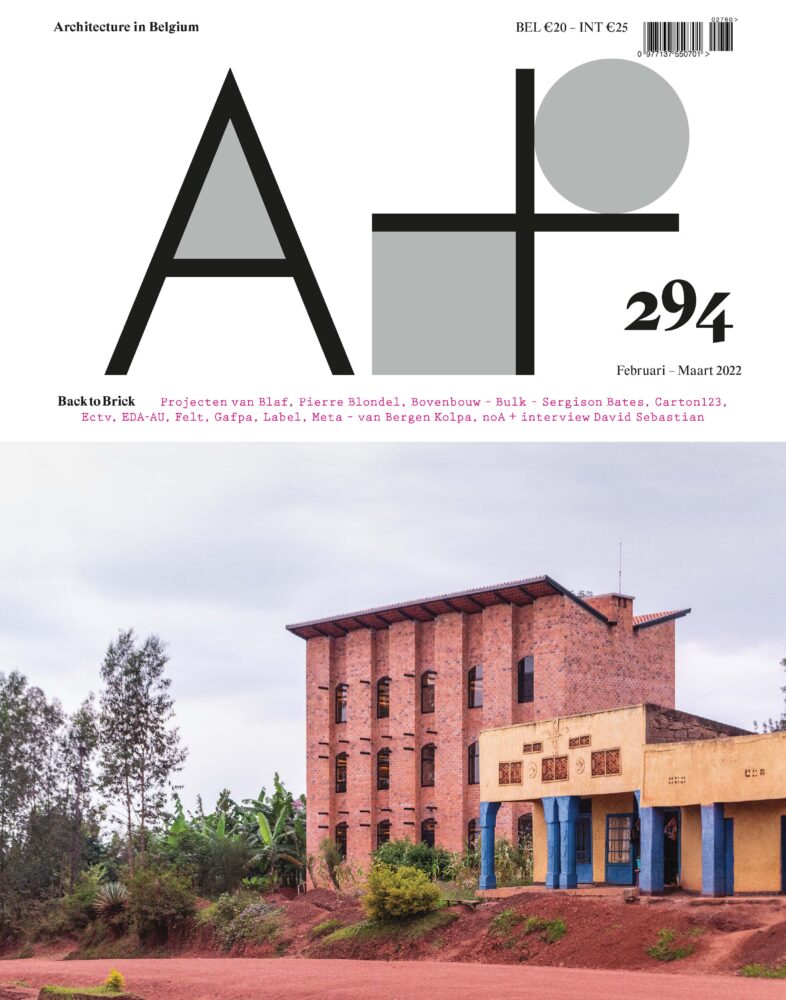


G1710 is a book about the work of GAFPA over the past 10 years.
The book includes contributions from artists Aglaia Konrad and Bert Huyghe, architecture critic Maarten Van Den Driessche, students from Studio PRIMARY STRUCTURE, and graphic designer Arthur Haegeman.
G1710 is published by APE (Art Paper Editions) and can be ordered online.
www.artpapereditions.org

On Tuesday 19 February at 6 p.m., GAFPA will present G1710 at Kunsthal Gent. G1710 is a book about their work over the past ten years.
The book contains contributions from artists Aglaia Konrad and Bert Huyghe, architecture critic Maarten Van Den Driessche, students from Studio PRIMARY STRUCTURE and graphic designer Arthur Haegeman.
www.kunsthal.gent
www.artpapereditions.org

Architecture education tends to gradually intertwine professional practices and teaching practices.
This leads to a transfer of theoretical subjects and questions, but also to testing the tools and protocols specific to each field. The publications of the Belgian agency GAFPA and the American agency Ultramoderne explore this convergence. The former pushes printing protocols to their limits, while the latter aims for uncompromising clarity of transmission.


The former Sugar Factory site along the Moervaart canal is an important part of Plusoffice’s Masterplan for the wider Moerbeke area. Following an intensive co-creation process with residents, the aim is to create a vibrant mix of local activity, diverse housing and medium-sized businesses. The area around Moerbeke is characterised by a varied and well-preserved open landscape, with rows of poplar trees, field lines and drainage canals. A high-quality setting for the compact village. The Moervaart canal acts as a natural border and prevents further urbanisation.
The redevelopment of the Sugar Factory site includes the creation of an elongated park zone along Moervaart, with new cycle paths along the recreational banks. A green ladder structure, perpendicular to the Moervaart, preserves sightlines from the historic Roman road and connects to existing slow village roads. Its location on the edge of the village, overlooking the fields, offers a unique quality. The project realises a first cluster of the master plan intended for mixed housing.

At the invitation of Maison de l’Architecture Midi-Pyrénées, GAFPA will give a lecture on the theme of “Architectures Domestiques”. The lecture will take place at the DRAC Occitanie, Salle des Anciennes Ecuries, on Tuesday 13 June at 7 p.m.

GAFPA has been invited to collaborate with PIOVENEFABI, Something Fantastic and Dyvik Kahlen Architects in supervising the second edition of the international Summer School, which will take place in Brussels from 26 August to 2 September this year. The focus of this Summer School is on Brussels office buildings and, more specifically, on the repurposing of the WTC building in the North Quarter. Registration is open until 5 June.

During REA#2 Summer School 2017, GAFPA will give a lecture on Thursday 31 August at 8.30 p.m. in the plinth of the World Trade Centre in Brussels. This will be followed by a discussion in the summer school bar.

The Carlton site in the center of Aalst is transformed into an urban housing project. A green collective inner area weaves through the building block and makes the connection between the Center Park on Zonnestraat, the triangular square in Windmolenstraat and the park garden of the adjacent Karmel site.
The warehouse typology of the existing architecture is used as a reference point for the project. Slim high volumes under a gable roof, fitted in a shared main direction but mutually offset, give the project a fine grain that is in keeping with the urban fabric and industrial past of the site. The volumes are cut off by the edges of the site, as a result of which the project presents itself differently on the different street sides: as a succession of gable ends on Windmolenstraat, as a sloping longitudinal facade on Zonnestraat.


PRIMARY TALKS is a series of lectures organised as part of the PRIMARY STRUCTURE masterclass. Throughout March and April, Manor Grunewald, Michiel De Cleene and UTIL will share their views on the theme in an open lecture.
The lectures will take place at the World Trade Centre in Brussels and are free to attend.

PRIMARY TALKS is a series of lectures organised as part of the PRIMARY STRUCTURE masterclass. Throughout March, Bert Huyghe, Pepijn Kennis and Aglaia Konrad will share their views on the theme in an open lecture.
The lectures will take place at Sint-Lucas Ghent, Sint-Niklaasstraat 27, and admission is free.

PRIMARY TALKS is a series of lectures organised as part of the PRIMARY STRUCTURE masterclass. Throughout February, March and April, Les Monseigneurs, Atelier Haegeman Temmerman and Jan Minne will share their views on the theme in an open lecture.
The lectures will take place at Sint-Lucas Ghent and are free to attend.

PRIMARY TALKS is a series of lectures organised as part of the PRIMARY STRUCTURE masterclass. Throughout March and April, Hannelore Van Dijck, Willem Boel and Klaske Havik will share their views on the theme in an open lecture.
The lectures will take place at Sint-Lucas Ghent and are free to attend.

PRIMARY TALKS is a series of lectures organised as part of the PRIMARY STRUCTURE masterclass. Throughout November and January, Christoph Fink, Aline Bouvy and Luc Deleu will share their views on the theme in an open lecture.
The lectures will take place at Kunsthal Gent and are free to attend.

GAFPA, together with AFGH, Alberto Veiga, Aristide Antonas, Bast, Job Floris, Johan Celsing, Lütjens Padmanabhan, Marcio Kogan, MAIO, Pedro Bandeira, Ted’A and Tom de Paor, was a guest at Porto Academy 2017.
The results of the workshop led by GAFPA form part of the design research conducted by the PRIMARY STRUCTURE studio.
www.primarystructure.net
www.portoacademy.info


The plinth floor of a residential tower in Brussels is in need of renovation. The opportunity is taken to immediately rethink the surrounding public space.
A covered gallery along the smoothed façade materialises the circular walkway and mediates between city and interior. A continuous perforated metal sheet is wrapped around the canopy, as a frieze and nodal point for graphic interventions.
The forecourt, previously hard capped by a blind retaining wall, is opened up to the street. A green embankment with loose steps forms an informal transition.
Intensive vegetation in the peripheral strips around the square enhances the public character of the place.

GAFPA, in collaboration with Arthur Haegeman Architects, wins the architectural competition for the renovation of the base of a residential tower in the Noordwijk district of Brussels.


In response to the exhibition Maatwerk/Massarbeit, the Flemish Architecture Institute, Het Nieuwe Instituut and the Deutsches Architekturmuseum are organising a series of debates entitled Frankfurt Dialogues. Dutch and Flemish architects will discuss their shared views on craftsmanship, customisation and spatial quality, despite their different cultural and historical conditions. Floris De Bruyn will participate in “Dialogue 1. Boundless Customisation” at Het Nieuwe Instituut Rotterdam on 27 October at 8 p.m.
www.hetnieuweinstituut.nl

At the invitation of curators Christoph Grafe and Bart Tritsmans of the Flemish Architecture Institute, GAFPA is presenting project G1203 at the group exhibition “Ensembles – Architecture and Craftsmanship” at deSingel International Arts Campus.

At the invitation of Jantje Engels and Marius Grootveld, GAFPA is exhibiting projects G1211, G1513 and G1609 at the group exhibition “Maatwerk/Massarbeit – Custom Made Architecture from Flanders and the Netherlands”. The exhibition is produced by the Flemish Architecture Institute.

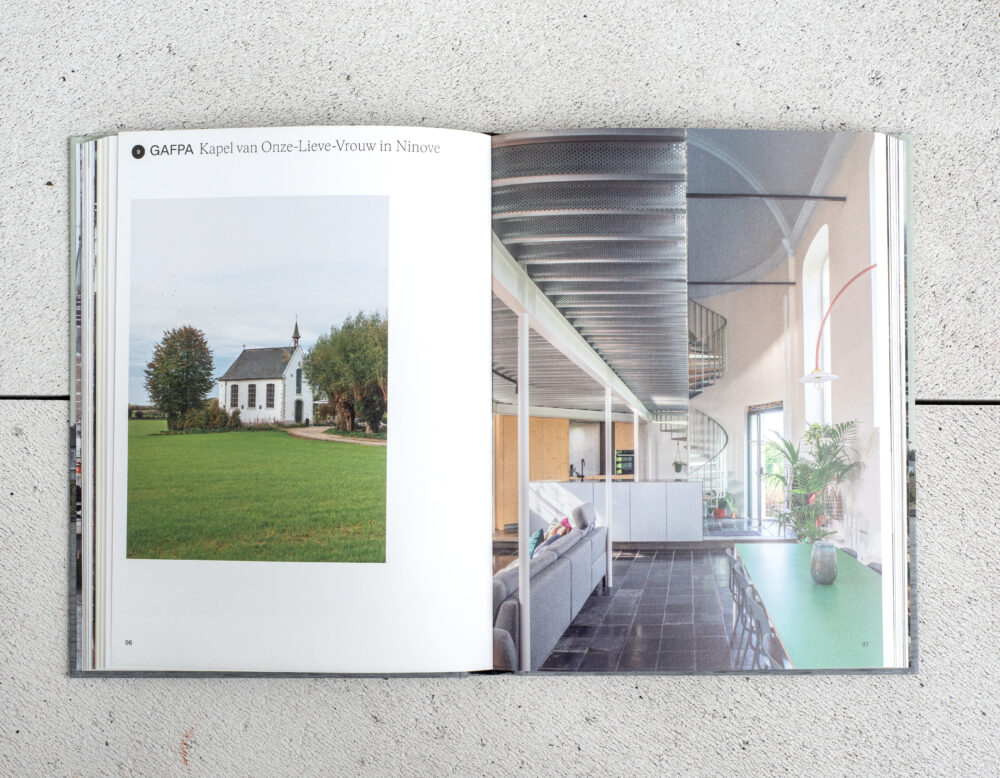
The Chapel of ‘Onze-Lieve-Vrouw ten Beukenboom’ in Ninove is being repurposed as a residence. The building, constructed in the 17th century at the intersection of three country roads, consists of three bays with a semicircular choir.
The exterior shell is being carefully restored. The stained-glass windows are being replaced with a combination of colored and clear glass, allowing daylight to flood in once again. The floor is being insulated and finished with the original tiles.
A light, demountable steel structure will be placed against the eastern wall, making the spacious chapel suitable for habitation. Two profiled steel intermediate floors protrude above a portico structure on the central axis of the chapel. In between, rooms will be furnished as wooden volumes. The construction is cut through by the semicircular choir, the existing front door, and a slender spiral staircase connecting the floors.
A new doorway in the choir breaks through the closed character of the chapel and offers a wide view of the fields behind it.


With the repurposing of the Onze-Lieve-Vrouw ten Beukenboom chapel, GAFPA was nominated in the Sustainability category and also received the Public Choice Award.
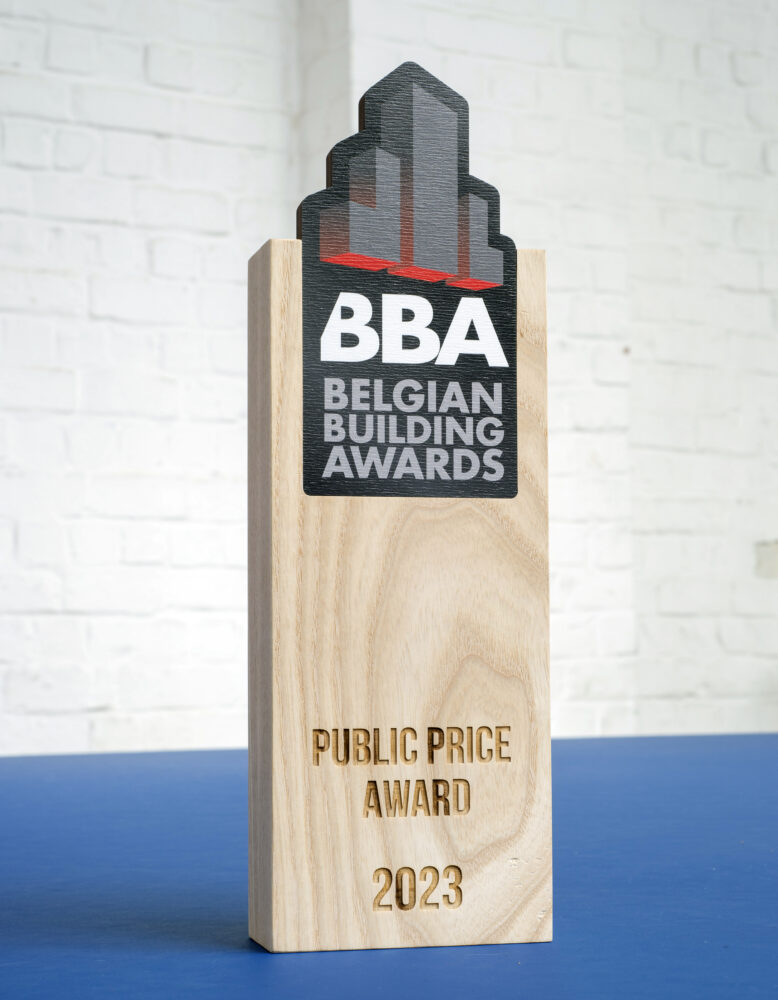

GAFPA and Studio Staal are joint winners in the residential buildings category of the 2022 steel construction competition with project G1609.
The jury, led by Stéphane Beel, praised the conversion of the old chapel into a home with adapted internal volume formation as a modest and reversible achievement. ‘The lightness of the steel structure complements its stone shell and forms a respectful contemporary addition.’
www.infosteel.be


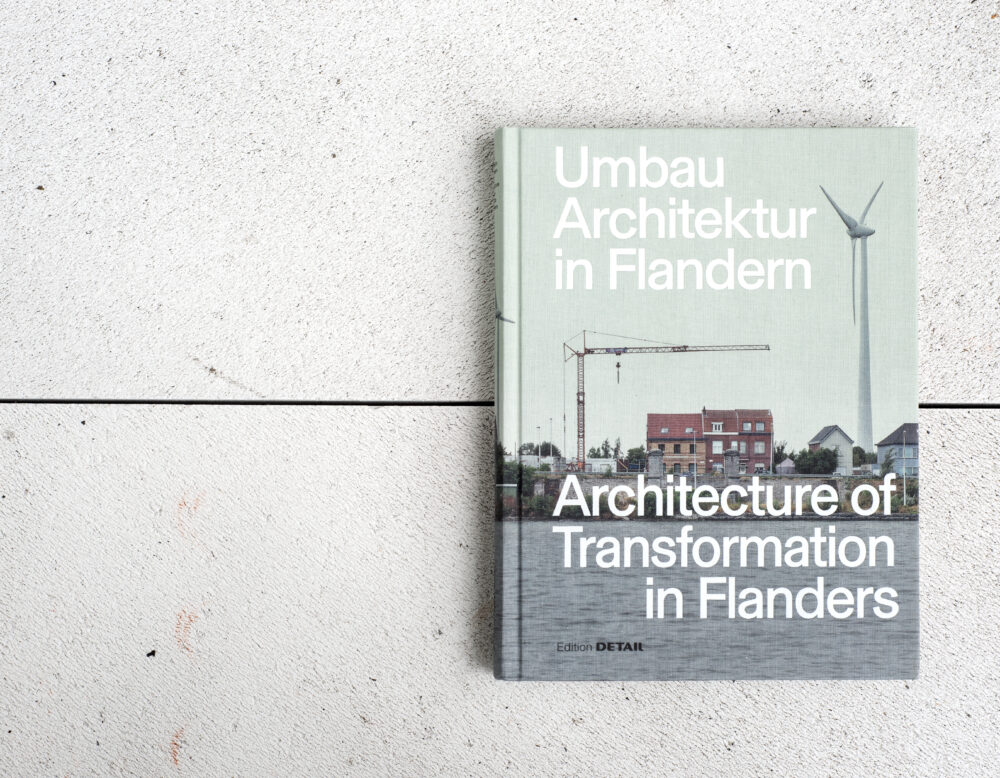


GAFPA will give a lecture on recent work at RWTH Aachen University – Faculty of Architecture. The lecture will take place in the Reiff Museum, Room 5, on Tuesday 10 May at 7 p.m.

Brasschaat’s fire station and municipal warehouse are both in need of an extension. The double architectural intervention brings structure to their shared site.
The fire station will be extended with a second vehicle hall and a compact living level on top of the existing hall. The new layer will be constructed entirely of solid cross laminated timber, like a light but robust storey-high roof.
For the new sheds, the profile of the pre-existing shed roof is maintained and folded around the corner of the plot; where the building strip widens, it is de-dug. This creates a staggered roof shell that allows daylight to penetrate to the back of the sheds. The same corrugated metal sheet returns as façade material in both subprojects – blank for the sheds, deep red for the fire station.


GAFPA wins the architecture competition for the renovation and expansion of the fire station and sheds of the municipality of Brasschaat.

In the A-Z lecture series, GAFPA will give a lecture on recent work at Hasselt University. The lecture will take place at Campus Hasselt on Tuesday 16 February at 8 p.m. and will be preceded by a debate at Campus Diepenbeek at 1.30 p.m. A-Z lectures is an initiative of Architectuurwijzer, Cultuurplatform Design, PXL MAD, UHasselt Faculty of Architecture and Art and Z33.

GAFPA will give a lecture on recent work at the University of Antwerp. The lecture is organised by Modulor and will take place on Thursday 10 December at 7.30 p.m. in lecture hall R.004.

A Ghent row house, two storeys under a flat roof, expands in height. A new storey is raised on top of the existing house, a symmetrical volume under a gently sloping roof that takes as little light as possible away from the shallow back garden.
The extension is composed of prefabricated solid wood panels, between which the new floor hangs like a light wooden grid. The structure is erected autonomously on top of the existing house. Only at the end of the yard is the old stairwell extended into the new volume, a light steel staircase makes the connection.


The redevelopment of Ghent’s Belgacom Tower is as much an urban planning project as an architectural one. Indeed, the current clunky T-shaped block, with its hard facades and raised plinth, does not seek any contact with the surrounding historic urban fabric, an imbalance that is corrected in the new design.
The gesture is to free up the main building, and graft four new slender volumes onto it. A light, horizontally articulated façade is wrapped around this new figure like a cloak, folded to respond precisely to the context. Terraces and urban gardens, stretched between building and façade, extend the urban life of the forecourt and surrounding park to the top of the building. A maligned, anti-urban monolith thus becomes a new, open and light, landmark for Ghent.

GAFPA, together with Coussée & Goris architects, Exedra, Studieburo Mouton and the Omgeving group, has won the architectural competition for the development of the Portus Site in Ghent. The project involves the concrete repurposing of the main building, known as the “Belgacom Tower”, and the urban development of the rest of the site as a master plan.
The urban planning agency BUUR from Leuven was responsible for organising the architectural competition.


A series of massive masonry barrel vaults characterise the old stables of the Grand Hornu.
The temporary wooden mould originally required to create this space forms the starting point of the scenography.
Several of these semi-circular wooden structures are arranged lying down throughout the space and introduce a new course.
The mould is again a temporary construction and acts as a fit for the exhibition.
“A mussel hides a mould and vice-versa. Magritte’s pipe is the mould of the plume of smoke.”
Marcel Broodthaers, 1966


GAFPA wins the architecture competition for the renovation of Ghent University’s student restaurant. The building is part of the Veterinary Medicine Campus in Merelbeke. The project involves removing previous ad hoc modifications to the original design by bOb Van Reeth and adding a new internal perimeter that restores the central focus of the space.
In this series of lunch lectures, GAFPA opens with a selection from its recent work. This lecture series is an initiative of Fragile, KUL Faculty of Architecture, Sint-Lucas Brussels campus.

The old single-storey warehouse of a row house in Ledeberg is replaced by a new wooden roof. As large a rectangle as possible, incised by the main building, is incorporated. Patios are created where the plane breaks away from the hilly plot boundary.
Two wooden nut beams in a T-figure support the roof, supported at their intersection by a new concrete column. The latticework follows the direction dictated by the main beams. Light walls made of aerated concrete create rooms and insulate the common

During the Festival of Architecture (F/a), two GAFPA projects will be open to visitors on Sunday 22 September.
‘G1015 Zwin Natuur Park’ en ‘G1508 Reconversie magazijn – woning’ will open their doors to the public from 10 a.m. to 6 p.m.
www.festivalvandearchitectuur.be

A room is being built in the garden of a villa. An abstract and elongated volume, sunk into the grass and hidden among the trees, embraces the garden together with the pond. Its end façade narrows gradually until only a door remains to announce the small building. It is a delayed and small-scale arrival: through the door, down the stairs, along the corridor, and then into the room.
Filtered by a sliding veil of expanded metal, it opens up across its entire width to the garden. A long worktop at ground level and a stove turn the space into a room.


The new lecture series ACROSS gives the floor to architects from various parts of the country who have established their own practices over the past decade. During this exchange, which will take place alternately in Antwerp and Liège, they will talk about their experiences and the specific physical and social context in which they practise architecture.
This lecture series is an initiative of A+ Architecture in Belgium, in collaboration with the Flemish Architecture Institute, the architecture faculty of the University of Liège.
www.a-plus.be

In the ERREUR(S) lecture series, GAFPA is invited to share their perspective on this topic. This will be followed by an open discussion.
This lecture series is an initiative of Les Ateliers Nocturnes, Faculté d’Architecture La Cambre Horta.

For the group exhibition “The production of Space”, GAFPA realised an installation in collaboration with photographer Max Kesteloot.
GAFPA’s model “Hangar I/II” makes abstraction of its surroundings, a landscape with other structures for which it was designed. It is isolated as a “final object” presented on two pedestals that are integral parts of the work. The mutual positioning of these two elements creates a suggestion of context in their field of tension. The concept of archetype is broken open by the dual nature of the work.
‘Untitled – Part I’ by Max Kesteloot is a photographic study of the site for which GAFPA’s architectural project was designed. In confrontation with model “Hangar I/II”, the series of four images evokes an insinuating narrative imagery, without substantive finality or completed scenarios.
(Fotografie: Max Kesteloot)


A terraced house in Wondelgem gets a new rear extension. The square ground plan is rotated according to the kink in the plot. A wedge-shaped opening is created between the extension and the main building, bringing daylight deep into the existing house.
The new roof is designed as a wooden shell structure of four mutually supporting planes. Centrally in the space, the roof is truncated, creating a generous skylight. Together with the wooden ring beam, the roof shells form a form-fitting structure, supported by the two side walls and a fine steel column.

A former dairy factory in Forest houses Anne Teresa De Keersmaeker’s dance company Rosas, and her dance school P.A.R.T.S. Part of the infrastructure is used by Ictus, an ensemble for contemporary music.
The architectural brief includes the main building and dance studios as well as the detached caretaker’s house. Picking up on the existing steel structure, the roof of the dance studios is redesigned, in search of a logical structure with a lightness and materiality that suits the needs of a dance company like Rosas. The main building and the caretaker’s house are freed from previous ad hoc modifications, and strengthened in their identity.

GAFPA was selected for the renovation of Rosas’ dance studios in Forest (Brussels). Rosas is the dance company and production and distribution structure surrounding choreographer/dancer Anne Teresa De Keersmaeker.


The literary magazine DW B 2014 5 reveals fifty fictional buildings from world literature. Fifty writers have described one place from a novel, story or poem in a short text. Fifty architects then made a drawing of this space – an image of a place that does not really exist, but which can nevertheless be visited and entered. Fifty texts, fifty drawings: read, look and wander through fifty fictional buildings in your mind.
At the invitation of Christophe Van Gerrewey, GAFPA depicted “Villa Avondster”, described by Benjamin Eggermont, from Robert Walser’s novel ‘The Assistant’.
www.dwb.be


Two historic buildings on the station square in Ghent jointly house the Gent Ecological Centre. The ground floor will be completely opened up and given a single shared entrance. The massive extension on the first floor is supported by five slender steel columns. Only the existing stairwell informally divides the double-wide space into restaurant and shop.
A new kitchen volume is fitted in behind the extension. A light timber structure under a pitched gable roof is stretched across the full width of the double plot. Through the kitchen’s transparent curtain walls, the interior space visually extends into the wedge-shaped terrace. The open corners between the main building and the new rear extension bring daylight into the deepest point of the building.

What is retained and what is changed in this monumental complex has a lot to do with the inspirational power, the soul of this special historical and industrial complex. Searching for the potential of the place and the building, in which the former use as a train factory and the future use as an office building cannot be separated.
The design is dominated by a long-term vision for the halls. The Van Gendthallen, a platform for makers, forms the basis for a new attractive, liveable and sustainably restored complex, adjacent to the centre of Amsterdam.

GAFPA is part of the design team selected to develop the repurposing of the historic layered building complex “Van Gendthallen” in Amsterdam.


The existing extension is demolished and replaced by an open space under a new gable roof. The ridge beam, designed as a slight vierendeel, aligns with the subdivision of the main building and sets a stride aside. It spatially suggests two zones: a narrower functional strip, and a wider completely free one. A bite from the roof leaves room for an existing window in the rear façade, casting light into the deepest point of the extension.
On the garden side, the roof shoots through into an awning, sheltering the terrace and the south-west facing facade. The folding window in the rear façade can be fully opened and the fixed window profiles hide invisibly behind the structure, allowing the space to extend uninterrupted into the garden


At the invitation of curators Chris Meplon and Moniek Bucquoye, GAFPA realised the scenography for the exhibition “Linked: the collection networks” in the Design Museum Ghent. On the ground floor, international design pieces are brought together around a few selected masterpieces from the museum’s collection.
Along the edge of the central glass floor, a light open cabinet is constructed from white cardboard. By lowering the adjustable glass floor two steps, the spaces inside and outside the cabinet wall offer different proportions to the collection pieces. From the outside, you can look over the cabinet and experience the exhibition space as a whole; on the inside, you get an interior experience on the scale of a room. Thus, the intervention generates different fragmentary perspectives on the design pieces on display.


The Flemish Architecture Institute invited five young design teams to form new images for our dynamic coastal landscape using projections, drawings, maps and models. The scenography of this exhibition was designed and elaborated by GAFPA.
A slender, storey-high structure is introduced. This picks up on the building’s existing concrete support structure and divides the open exhibition space. Where a window gives a view to the outside, the structure is covered with a blue fine-mesh net; a filter for the spaces behind, creating a visual and spatial tranquillity. Places are created, each with a specific spatial character. The friction between the temporary structure and the heavy concrete existing building fragments and frames, simultaneously exhibiting the building itself.

The 12th edition of the Architectuurboek Vlaanderen (Flanders Architecture Book) brings together the most talked-about examples of recent architecture in Flanders. Together, they tell a story about the role of architecture in a complex European context.
Recent developments in architecture are discussed in thirteen essays, which include G1106, G1203 and G1304.
www.vai.be

Two dilapidated row houses at a busy intersection give way to a new building. A building-high claustra shields the house from the intersection and nearby train traffic, and corrects the slope in the plot shape.
Behind the claustra, the house stands as a light and compact stack of plot-wide rooms. Initiated by the generous ceiling height of the living space, the rooms stagger half a floor each, arranging themselves in stages along a central void.
A fine structure of smoothly polished concrete slabs spans the full width of the house with minimal thickness. Wide band windows and fully glazed interior joinery lend lightness and transparency to the shallow building


As part of project G1015 Zwin Nature Centre, the tourist infrastructure on the Dutch side of the nature reserve will also be renewed. The old beach pavilion will be demolished, except for the foundation slab. A closed building volume gives way to a light steel canopy construction under which a narrow volume stands as a windbreak. At its rear, this wooden wall opens up a series of sanitary rooms.
The new beach pavilion acts as an info and gathering point for visitors to the Zwin nature reserve.

The initial plan for a complete renovation of the existing tourist infrastructure proved unfeasible within the available budget. Instead, a more modest intervention is proposed, retaining the existing concrete slab as the foundation for a lightweight steel canopy structure.
Within the same footprint and using minimal resources, an information point is created that emphasizes an outdoor experience. In this way, the project shifts from an energy-intensive museum to a contemporary beach pavilion serving as an information and gathering point for visitors to the Zwin Nature Reserve.

The historic building, on the flank of the Wall of Geraardsbergen, needs breathing space. The lay-out of the floorplans are identical – three identical rooms, connected around a central corridor.
The ground floor is completely cleared. The staircase is moved to the wedge-shaped side strip, swelling to fill it completely. Where walls once stood, there is now a slender steel column structure that supports the rest of the house. The dividing beams echo the old floor plan, recalling the size of the rooms.


At the invitation of Architectenhuiskamer, GAFPA is presenting project G1212 at the group exhibition “Verloren Ontwerpen” (Lost Designs), an exhibition featuring models of designs that were never realised.

The design is a thorough conversion of a country house in Brakel. Behind a representative façade hid an otherwise largely closed house. The design recovers this shell, but punches new openings where necessary, or connects existing holes.
A square cut-out of the ground floor plan is almost completely cleared. The interior walls are demolished and replaced by clunky wooden beams. A completely open side façade retreats from the old one, using the existing wall with its huge new opening as a screen and frame, to bring in light and cast new views of the landscape.
The mansion’s entrance hall falls just outside the new box. It does not need to be isolated, and so can retain its ornamentation and representative character.


The house is designed as a stepped volume, with the intention of making the most of the orientation of the site. Due to its specific shape, the volume shows itself differently from every vantage point.
By stepping back from the plot’s side line, the side strip, which usually remains as a three-metre-wide residual space, can swell into a usable space. The gearing also allows the upstairs bedrooms to look out over the garden past each other, allowing them to turn away from their neighbours while still getting plenty of light and views.
The ground floor threads together three identical rooms, one each shifted opposite the other. This shift gives a diagonal view from the street to the garden side, and along the flat, largely closed side façade leaves room for the darker functions.

At the invitation of curator Michael Meredith, GAFPA is exhibiting a model of G1204 at the group exhibition “44 Low-resolution Houses” at North Gallery, Princeton University School of Architecture.
The exhibition runs from 11 September to 9 November. (Gif: MOS/studio Lin)
soa.princeton.edu


A former stonemasonry is accessed by a gatehouse along Leo Tertzweillaan in Gentbrugge. The site is being redeveloped as an inner area with a cluster of new residential entities and small studios. The client owns part of the site where a concrete canopy adjoins a higher steel-structure shed.
The design leaves these structures intact and adds a third, light wooden structure. A compact wall-to-wall two-storey residential volume is slid under the roof of the higher shed against the side walls. From the concrete canopy, roof and floor slab are cut out to create a walled garden. The existing concrete structure will be retained in the garden and copied in the wooden support structure of the house.

The transformation of a former stone quarry in Ghent into a single-family home starts from a well-considered, strategic approach that focuses on typological continuity. A careful reading of the existing structure shows how a typical steel shed was previously incorporated into the site by cutting away parts of the existing concrete structure, whereby the new rhythm was carefully attuned to that of the original concrete structure.
The new design builds on this intervention by introducing a timber frame that seamlessly fits into the same bay rhythm of both the concrete and steel construction. This frame translates the structural logic of the concrete frame into wood and thus reflects the original force effect in a new material.
The project demonstrates a radical economy in the use of resources. The polished foundation is insulated at the bottom and serves as a finished floor on the ground floor. Thanks to the optimized timber frame, floors and ceilings can be constructed from 4 cm thick wooden planks, which are installed on site without a crane.
All connections are designed for easy disassembly: wooden connections are reinforced with concealed steel fins and metal pins. Non-load-bearing additions are deliberately designed as such and clearly distinguished, with a view to future adjustments.

A semi-detached house is completely renovated and extended with a kitchen volume. A long and narrow transparent volume is added, which inserts itself into the elongated garden. This creates optimal light in the dining area in one move and gives the cooking area a special experience. The difference in height with the side path provides the necessary privacy. The new design is incorporated into the volumetrics of the closed side façade.
The structure consists of a wooden roof structure supported by fine round steel profiles. The volume is enclosed by a light wooden glazed curtain wall.

With limited space and resources, an extension is added to a house in Ghent. In the choice of materials, no distinction is made between inside and outside space: the concrete brick walls and flooring continue from the kitchen into the small courtyard. Light folding windows allows the two spaces to be separated or, in summer, to merge completely. Two identical metal doors give access to a small outdoor storage room and the street behind.

In the construction of a new timber production hall, circularity is the central principle. All techniques used are fully demountable and designed for reuse. The lightweight cladding in profiled metal sheets and the steel structure follow well-established circular methods.
The main challenge lay in the loading and unloading bays, where concrete was required for reasons of durability. To meet this need without compromising the circular ambition, industrial stacking blocks were reused—massive concrete elements that, like oversized LEGO bricks, fit together without mortar. This approach avoids waste, allows for future disassembly, and gives the building a bold, robust character. In this way, reuse becomes not only a technical solution but also a defining aesthetic quality of the project.

The design makes the connection between two attic spaces, across the intervening roof. One wall of the attic studio is fully opened up. A four-piece opening window overlooks a roof terrace and a green roof. A three-part spiral staircase rises to a mirrored metal dormer, and the door to the attic of the front house.

The plot lies at the end of a ribbon development and gives a view of agricultural land. The plot slopes down to the Moervaart canal and is overgrown with yellow forsythia, typical of the area’s sandy soil.
Like a modern stilt house, the timber structure rests on a light foundation of precast concrete T-elements. The plan is conceived as an uneven U-shape that opens to the landscape. There is a living space at each end, both with their own covered outdoor space. An elongated closet wall separates the sleeping quarters from the interior corridor.
The facade is conceived as an aluminium frame, filled in with wooden panels or glass, wrapping the entire building. The combination of timber frame construction, infilled with paper flakes, and triple-glazing results in a low-energy house. A tree was planted to filter sunlight. Expanded metal shutters guarantee privacy to neighbour and street.
Special mention – Belgian Building Awards 2015

This project uses a foundation made of reclaimed prefabricated T-elements, which were originally used as retaining walls. These replace the traditional cast-in-place concrete slab with a demountable and reusable solution. By partially elevating the elements above ground level, the structure resembles a stilt house, protecting the wooden superstructure from water and moisture. The T-elements can be easily excavated and reused.
The timber structure, placed on top of the concrete T-elements, consists of CLT panels combined with a timber frame. The walls are insulated with blown-in cellulose flakes, providing an efficient and sustainable thermal envelope. A green roof increases thermal inertia and enhances the ecological performance of the building.
The entire design is based on the dimensions of a standard wooden façade panel. The façade is made up of wooden and glass panels, held in place by visible screwed metal U-profiles. This choice allows for easy disassembly or modification of the façade and reinforces the tectonic expression of the building—making the structural logic visually legible.


The house is parallel to the street and at an angle to the plot. A timber structure is erected in the armpit between the house and the common wall, elongated like the length of the plot. The simple rectangular volume is composed of a rhythmised series of pine rafters, integrally glazed on the longitudinal side and fitted with a double-opening window at the head. This frames the garden view, while the four-metre-high glazed curtain wall lets in ample daylight.
As shading, a gable board is attached to the structure vertically, like a fin. By building against the side, the original house retains its individuality and daylighting, while creating a new cohesion. The old front door moves to the side of the house so that the existing layout can be optimised.

The ground floor of a 1950s house is being reorganised. The existing floor plan is retained. A new volume is added, pushed against the rear of the house, creating a patio between the extension and the living space inside. The extension is conceived as a freestanding roof structure resting on four slender steel columns.
The timber structure consists of four interlocking main beams that form a central rooflight. Where the extension touches the outdoor space, it is bordered by folding window. The garden wall continues inside, leaving only the feeling of an open canopy in summer. Expansion profiles in the polished floor show the force action between the columns.

The bird and nature reserve “Het Zwin” is a protected nature reserve on the border between Flanders and the Netherlands. The brief calls for the redevelopment of the existing nature park and the creation of a new nature centre.
The design proposes a breach of the silted-up forest to make way for a valuable mudflats and salt marshes area and connect to the reconstructed Kleyne vlakte. The existing car park gives way to a new ensemble of four elongated volumes, conceived as wooden porch structures of varying height. These contain a reception hall with cafeteria, the exhibition hall, and staff and seminar rooms.
A minimal presence of cultural signs is envisaged in the park. A Viewing Centre is envisaged in the embankment, providing a view of a central bird nesting area.
BREEAM Certificate – Excellent

This week, the new Zwin Nature Park was officially opened. GAFPA would like to thank the entire design team for the successful collaboration.
From 10 June, the Zwin will once again be open to the general public.
www.zwin.be

The new Zwin Nature Park is one of 356 projects nominated for the EU Mies Award 2017. The award will be presented in April 2017 by the European Commission and the Fundacio Mies van der Rohe.
www.miesarch.com

During the Festival of Architecture (F/a), two GAFPA projects will be open to visitors on Sunday 22 September.
‘G1015 Zwin Natuur Park’ en ‘G1508 Reconversie magazijn – woning’ will open their doors to the public from 10 a.m. to 6 p.m.
www.festivalvandearchitectuur.be
The 13th edition of the Architectuurboek Vlaanderen (Flanders Architecture Book) brings together the most talked-about examples of recent architecture in Flanders. Like the mustard factory on the cover, the selected projects raise questions about the meaning of form in architecture. This publication by the Flemish Architecture Institute presents a rich selection of recently completed projects in words and images.
G1015 Zwin Nature Centre is presented as an architectural project and is also the subject of a visual essay.
www.vai.be

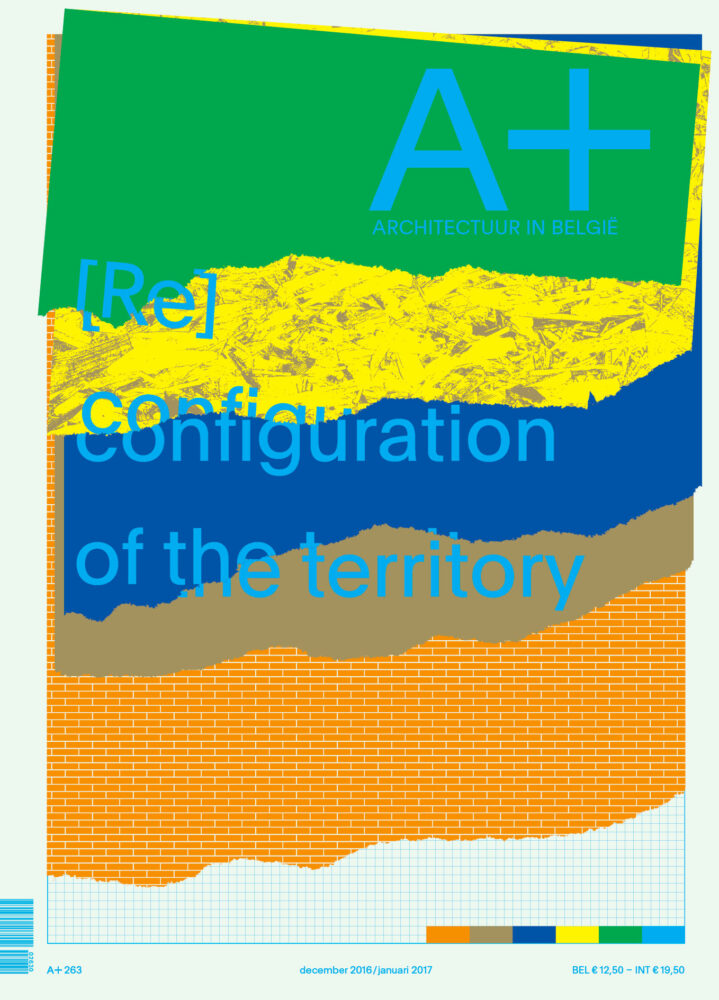


GAFPA was asked to design the scenography for the end-of-year exhibition of the architecture course at Sint-Lucas Ghent. The design aims to create a split between two-dimensional and three-dimensional media. Models were placed on the floor in strips of a certain width, drawings were hung on panels of the same width at the bottom of the mezzanine. The combination of the uncluttered two-part structure of the scenography and the multiplicity of the work on display was meant to give rise to a search for connections.


Rather than needlessly expanding, the design makes the best possible use of the space that was already available. The floor plan is broken open and three one-legged tables are introduced: two inside, and one outside. The outdoor table, its top a light steel frame filled in with a steel deck plate, is held upright by a slender steel profile, and covers a newly constructed terrace


At the invitation of curators Philipp Stemath and Julian Brùes, GAFPA contributed to the group exhibition “Models” at Forum Stadtpark Graz.
The exhibition runs from 23 September to 2 October.
(Fotografie: Simon Oberhofer)
www.diskursiv.xyz


In a long, tapered plot, a tightly rhythmic extension brings structure. A sequence of three rooms of equal length, the third left open as a garden, fills the site. The remaining spaces at the ends form a small hall and a garden shed.
The dividing line between the rooms is articulated by a double steel U-profile, resting on transverse piers that vary in width to accommodate the slope of the plot. The wooden roof structure runs parallel to the walls over these profiles, emphasising the length of the site and the extension.


The street level is much lower than the surrounding meadows, blocking any possible vista. To reconnect the vast landscape to the street, the house was lifted to the top of the existing embankment. An entrance is excavated under the building, which opens up the house laterally and flows out into the landscape behind via a staircase. This again adds depth to the streetscape.
The ground plan is organised by a cruciform concrete structure, which connects to a central diamond-shaped chimney. On the ground floor, the structure remains open and the four quadrants flow into each other; on the first floor, they are filled into four equal


St Lievens College in Ghent grew out of a former monastery site around St Peter’s Church. The existing school complex houses a primary school and a nursery school.
The masterplan has a double ambition: on the one hand to centralise the administrative services in one recognisable transparent building volume, and on the other hand to create openness by creating a green axis connecting the various playgrounds.
The plan principle provides for a separate circulation shaft per two classrooms, so that the classrooms on both sides face the external façade and the traditional corridor is avoided. This creates a clear circulation and a solution for the concentrated flow of pupils at the bell.
Despite the expansion, the masterplan provides oxygen and overview in the dynamic context of a growing school.

At the invitation of Architecture Workroom Brussels, GAFPA is participating in the Future Places Forum debate, Conversation #3 “A New Architectural Language”.
www.degroteverbouwing.eu


